India through my eyes: Sights, sounds and memories

Dr. Jayan Philip is a Contributing Writer at The ArmChair Journal. He is a distinguished History educator with over three decades of teaching experience in India and abroad. He is the author of ‘The Indomitable Gandhi, The Indefatigable Mandela’, ‘Quintessentially Quizzical’, and the forthcoming ‘The Cute, the Naughty, the Fluffy, and the Most Faithful’. A noted quizmaster and prolific writer, he has conducted nearly 204 quiz shows and has 37 publications to his credit. Through his scholarship, writing, and engagement with young minds, he continues to foster historical understanding, critical inquiry, and a lasting love for learning.
My first visit to Bangalore, or Bengaluru as it is called today, was with my mother in 1979. There were canopies of trees where the sun’s rays would strike my eye as I used to get into the red buses at that time. One of the numbers which has still stayed with me and is reminiscent is 123. It used to wind its way through the present Indira Nagar and then reach Shivaji Nagar. It was a dream come true for many Malayalis to visit Bangalore once in their lifetime in the 70s, for many reasons, but primarily to enjoy the scenic beauty and the wonderful climate, which each one treasured. It was not Silicon City, nor was there an Electronic City within Bangalore City, but only a Bangalore East and Bangalore Cantonment. The Majestic area, which is regarded as the central point of arrival and departure by road and rail even today, was so called because of the famed Majestic theatre in those days.
I recollect my evening strolls, which were more about having a pack of nuts in a triangular-shaped paper cone priced at 2 rupees. Most of us loved the one and two rupee coins, as they were saved for the evening kapalandi packet (packet of groundnuts) known for its spicy flavour and bright, chilly-coloured exterior. The flavour lingered on, and so did the temptation to buy one every evening, quite contrary to the Theo Brahamas, Glenns, and Ammas, which serve mouth-watering cakes and snacks to passersby and regular customers as of today. I recollect the All Saints bakery, as the name was fresh in my mind because some of my friends went to the famed All Saints College for girls in Trivandrum.
Later, when we boys would take our usual Bangalore trips on the Island Express from Trivandrum, each of us would sit glued to the window, watching in quiet excitement as the train slowly pulled away from the city. The scenery grew greener with every passing mile, and from the breezy rush of the moving train, All Saints’ College would appear tiny in the distance, like a matchbox nestled among the trees. It was common chatter in those days that girls’ scores were much better, which we had to accept on our train journeys reluctantly.
During one of my early intercollegiate quiz competitions in the 1990s, I was puzzled, intrigued, and excited by the answer to a particular question: “Which is the largest public sector undertaking in the world?” The answer was Indian Railways, and it seems to hold even today. As the Indian Railways runs through the length and breadth of India, the innumerable landscapes that appear and disappear include the lush green paddy fields, rivers, forest cover, dry regions, caves and bridges like the iconic Pamban and Howrah bridges, which connect the town of Rameshwaram to mainland India and Kolkata to Howrah, respectively. The Taj was in my dreams, and images of the marble in the edifice throughout the 80s and 90s never left my mind. Perhaps the captivating beauty of a portrait or painting of the Taj Mahal etched its images so deeply into my mind that they would flash before me again and again, whether awake or asleep.
My first journey to New Delhi was in 1990, after my last exams for my BA (History). This was coincidental, as my centre for the TOEFL (Test of English as a Foreign Language) exams was New Delhi, my third choice, after the first two, Trivandrum (Thiruvananthapuram today) and Bangalore (Bengaluru today), were not granted. The Kerala Express wound its way from Trivandrum to Delhi, and the two-and-a-half-day journey was the first eye-opener for me, as each station offered linguistic and cultural diversity in terms of language, script, dress, and food. One thing remained the same throughout, but also changed with every state. The yellow railway signboard displays the name of the city, town, or village, which is uniform throughout India, but the name of the place in the official language changes as the train crosses the border into another state.
As the train passed by Agra on the third day morning, I glanced out of the window and saw the Taj at a distance, a monument which was commissioned in 1631 and completed in 1653, that stands as a reminder of the beauty, tranquillity, and effervescence of an architectural wonder in a country called India. The Kerala Express continued its journey towards New Delhi, the wheels moving in perfect sync with the recurring sounds along the parallel rail lines. The Taj disappeared from my view but not from my mind, thoughts, or dreams. Many years later, when I visited the Taj with my family, the first sight was indescribable but memorable. If this was and is a wonder, I had just seen within a gap of two hours one of the largest gateways in the world, the Bulund Darwaza and stood exactly in the same place where Akbar once stood, administered and ruled- Fatehpur Sikri, the capital of the Mughal Empire under him.
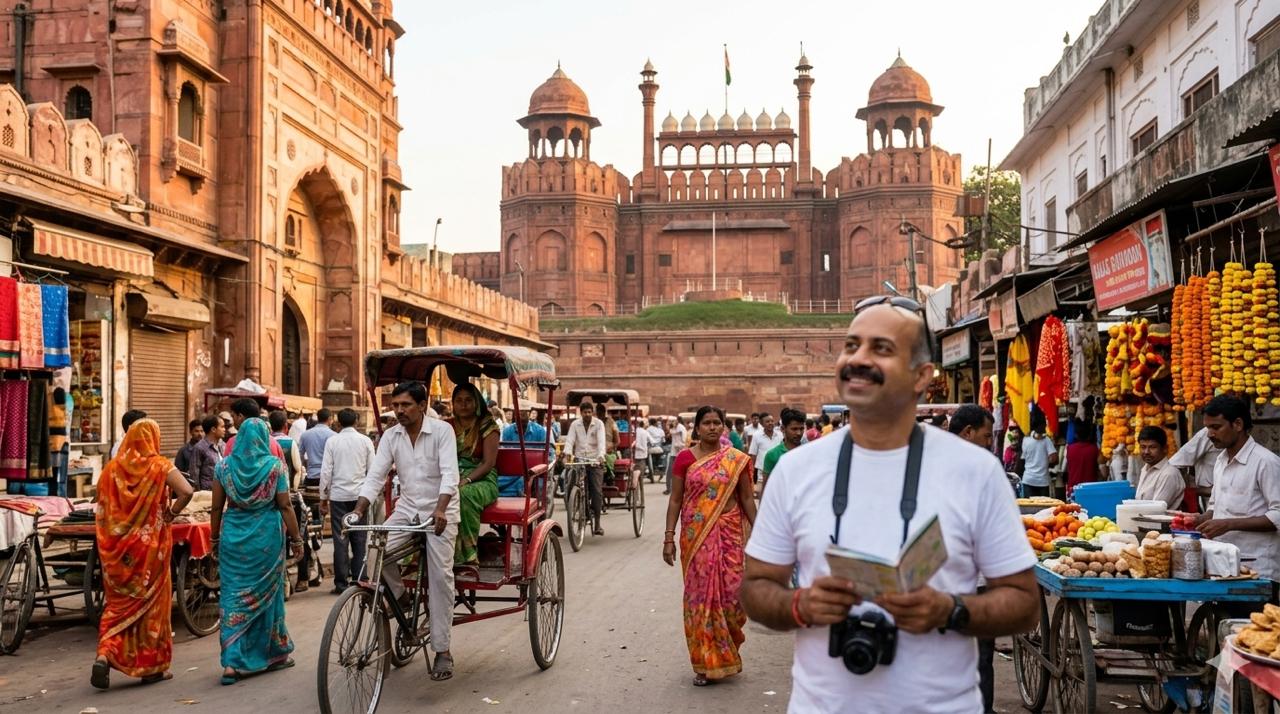
The two forts which most Indians have heard of are the Agra Fort and the Red Fort. Both are different in terms of location but hold immense historical value and significance. Shah Jahan’s Red Fort once housed the Peacock Throne and served as the seat of Mughal authority. The fort combined military defence with beautiful Mughal architecture, including gardens, audience halls, water channels, and palaces. Although India gained independence on 15 August 1947, Jawaharlal Nehru ceremonially hoisted the national flag at the Red Fort on 16 August 1947. Since then, the Prime Minister of the day has continued the tradition of hoisting the Indian Tricolour on 15 August each year to mark Indian Independence Day. It was in the very same Red Fort that Bahadur Shah Zafar, the last recognised Mughal ruler, held his court before being captured by the British during the Great Indian Revolt of 1857 and exiled to present-day Myanmar (formerly Burma).
The INA trials (Indian National Army which was led by Subhash Chandra Bose) of 1945–46 came to be famously known as the “Red Fort Trials” because they were held at the historic Red Fort in Delhi. During the proceedings, thousands of people from all walks of life gathered in support of the INA officers and raised the powerful slogan: “Lal Qile se aayi awaaz — Sehgal, Dhillon aur Shah Nawaz.” The slogan reflected the immense public solidarity for the three officers — Prem Kumar Sehgal, Gurbaksh Singh Dhillon, and Shah Nawaz Khan — who became enduring symbols of Indian nationalism and resistance against British rule.
My tourist guide led me to the same room in the Agra Fort, where Shah Jahan was imprisoned in his last days. He told me something that reminded me of the fragility and mortality of life: that every human has a specific time to live in this world, and that the impact you leave is much more significant than who you are. Shah Jahan used to look at the Taj Mahal with tears rolling down his cheeks and over to the long, grey-haired beard.
Speaking about forts, my mind is still wandering around it. I teach Chinese Civilisation to my sixth graders every year, and they all start with the Great Wall of China while making their mind maps and forming their inquiry questions. Still, it was only three years ago that I happened to read about the Kumbhalgarh Fort in Maharashtra, which has the second-largest continuous wall in the world after the one in China. India is a land of forts, and the two larger states, Maharashtra and Rajasthan, are home to most of them. I have been to Jaipur only twice, but the Hawa Mahal keeps any visitor spellbound. The structure itself is an artistic impression crafted in stone, with precision and a perfect blend of hues. It appeals more at night when it is illuminated, adding to the colour and the kaleidoscopic images it can create through the lens of cameras or mobile phones. Jodhpur and Jaisalmer were very different from Jaipur, and the latter appealed to me more, with its dunes and desert sands, and the sight of camels was a welcome sight for the visitor. The night in Jaisalmer, in the midst of the desert, and witnessing the Kalbeliya dancers balancing five or six pots on their heads is not just thrilling but a rare experience, because it is perhaps performed only in the northwestern parts of the country.
In 1990, New Delhi was a bustling city, filled with throngs of people hurrying along the streets, much like busy bees. I was on my way to the TOEFL exam centre when I noticed my auto driver’s sudden frustration. I hesitated to ask him what was wrong, but a glance at the roadside board provided the answer: “Archaeological excavation in progress, inconvenience regretted.” The usual flow of traffic was disrupted, thanks to the efforts of our unsung heroes — archaeologists and historians who were potentially uncovering treasures that would one day shed light on Delhi’s rich history.
Delhi, as it stands today, is a city layered with a past that cannot be overlooked. The legacy of the five dynasties of the Delhi Sultanate is deeply imprinted on its fabric, creating a historical context that is both complex and fascinating. One of the city’s most notable landmarks, the Qutub Minar, stands as a testament to enduring architecture; this tallest brick minaret has weathered the trials of time, even surviving a powerful lightning strike. It is not just a structure but a symbol of the cultural and historical richness that defines Dilli (New Delhi).
The Lotus Temple, to me, looks like a lotus in stone. We have tried several times to grow the lotus on our terrace, but success has always eluded me; the backwaters in Kerala and the ponds and small lakes in the countryside of Karnataka and Tamil Nadu have countless numbers of the pink lotus in full bloom, with their green stalks gracefully rising above the water. It is a sight worth a thousand clicks on any camera, one that is always etched in people’s minds or glanced at.
The logo of Gujarat Tourism is the roaring Asiatic Lion. It can be seen in the Gir Forest, the only place in the world outside Africa where lions live in the wild. They have bigger tail tassels and bushier elbow tufts than their African counterparts. After landing at Sardar Vallabhbhai Airport in Ahmedabad, I was curious to know where the Sabarmati Ashram was, and my auto driver replied, “Sab, ye rasta mein hai” (It is on our way). The next day, I lost count of how many people just barged in to see the place that once housed the Mahatma, who led India’s three most vital movements against British rule — the Non-Cooperation Movement, the Civil Disobedience Movement, and the Quit India Movement. It was from this very place that the historic Salt March was launched on 12th March 1930, an event that shook the foundations of the British Empire. Great leaders and personalities from across the world, including Martin Luther King Jr., Bill Clinton, George Bush, Donald Trump, Barack Obama, Shinzo Abe and Nelson Mandela, have visited the ashram and paid tribute to its legacy.
Standing there, I could truly feel the spirit of sacrifice, courage, and simplicity that still lingers within its walls. The visit was not just a journey through history, but also a reminder of the power of truth and non-violence in shaping a nation and inspiring the world. Besides the historical and geographical significance of Gujarat, the Garba and Dandiya dances performed by men and women in colourful, mesmerising costumes during the Navaratri festival can fill the world around with exuberance and vibrance, as large numbers of people dancing to the rhythmic beats across cultural and linguistic backgrounds reflect the true spirit of a pluralistic India. Many times, I have tried the Dandiya not for the love of dancing but for the sticks, which still have a permanent place in my car.
Kumarakom in Kerala is famed for its serene backwaters and the Vembanad Lake; one-hour cruises make for an unforgettable experience, as the gentle ripples in the water create distinct sounds and soothing patterns. This, along with the silent chirping of the sparrows from the tall coconut trees, gives the short voyage on the houseboats a timeless charm and memories of a lifetime. Munnar is special to me since I was born there. My mother’s ancestral place is here, surrounded by and dotted with tea plantations, with the mountains forming a backdrop. During the rains, the small waterfalls become places for social gatherings and gossip, too. The KSRTC runs special double-decker buses today, keeping passengers engrossed, as their eyes have little else to rest upon except the vast green cover and the treetops stretching endlessly around them. The tea gardens, neatly pruned and spread uniformly across the valleys and lower regions, are pleasing to the eye and soothing to the soul. Besides all these natural wonders in green, it is the colour purple that probably becomes the apple of the eye in Munnar. The Kurinji Poov (Kurinji flowers) blooming across the mountains form a magnificent purple cover and present a breathtaking sight. However, one can witness this spectacle only once every twelve years. So, a 12-year wonder becomes a cynosure of all eyes.
I haven’t been to Scotland, but I often speak about and visit the Scotland of India – Coorg. Its misty mountains, lush green plantations, coffee estates, cool climate, and vast green cover reminded me of Scotland. We stayed with a Coorgi family, enjoying the local dishes, but the most memorable one was a complimentary ride to Wayanad, which is close by. I could only see a few houses in the dark, but that night drew me closer to the pristine green canopies of trees and flowers in full radiance in the morning. Deep, dense forests, just one colour: green, but the different shades and hues are clearly distinguishable and elegant. A sight to behold at that moment, but a narration beyond words forever! It was a drive worth revisiting, perhaps for longer durations, free from the hustle and bustle of Bengaluru.
Sikkim joined India in 1975, becoming the 22nd state. Every person who lands at Bagdogra Airport in West Bengal would be greeted by drivers of custom-made jeeps, designed to navigate the rough terrain of mountain roads. Visitors have two options: either drive to Darjeeling or to Gangtok, the capital of Sikkim. My family chose Sikkim. On the way, we see the Teesta River, considered Sikkim’s lifeline and distributed geographically across the region. Rafting on the Teesta is an exhilarating experience. The swift currents and sudden rapids keep rafters’ adrenaline levels soaring throughout the journey. Before we began, the captain of our raft firmly instructed us to follow two essential safety rules: keep our feet securely wrapped around the thick rope at the bottom of the raft, and wear our life jackets at all times while on the Teesta. As rafting began, we drifted towards an unknown destination for us but known only to the raft’s captain. I could feel the sharp rocky tops down the course of the Teesta, sitting on our raft.
This was in June 2022, and we had to rush back to Bangalore as I had to defend my PhD thesis. Standing inside Kolkata’s airport, I was tense, walking around, when I just happened to glance up and noticed something special or extraordinary that was not found elsewhere in India: the Bengali alphabet inscribed on the ceiling. This is a true reflection of India’s linguistic diversity and distinctiveness. This uniqueness is perhaps profound as we traverse the length and breadth of our country. Howrah Bridge and Vidyasagar Sethu are great examples of engineering expertise and human endeavour. The former was built before Independence and renamed Rabindra Sethu in honour of Rabindranath Tagore, and the latter in honour of the great social reformer Pandit Ishwara Chandra Vidyasagar. The latter was built to reduce the traffic of the former.
More recently, As the motorcade wound its way through the quaint, hilly town, a sea of green-clad schoolgirls from Dharmashala eagerly awaited the revered figure, their faces aglow with anticipation. From our vantage point in the Urbania van, the scene was nothing short of captivating – a testament to the enduring spirit of compassion and justice. The air was alive with the vibrant hues of maroon and yellow robes, as Buddhist monks stood shoulder to shoulder with the masses, united in their quest for freedom and equality. The moment transported me to the CTA (Central Tibetan Administration) building, where the portraits of the Dalai Lama and Mahatma Gandhi hang side by side, a poignant reminder of the power of conviction and nonviolent resistance. As thousands gathered to catch a glimpse of the Nobel laureate, the atmosphere was calm and composed, with a sense of purpose and unwavering resolve. Standing alongside my students from Neev Academy, I felt a deep sense of pride and wonder as I witnessed firsthand the embodiment of hope and resilience in His Holiness the Dalai Lama.
The Attari-Wagah Border stands as a poignant reminder of the transformative power of resilience and unity in the face of adversity. Born from the tumultuous division along the Radcliffe Line, this border has become a beacon of hope for a brighter future. Amritsar, having borne the weight of history, now serves as a testament to the indomitable human spirit. As we move forward, we recognize that while geography may be unchangeable, our understanding of history can be reimagined and reconstructed through diverse perspectives and collaborative initiatives. This afternoon, as I stood among thousands, along with my school, Neev Academy, I was filled with pride and a sense of purpose, reminded that even the most challenging chapters can be transformed into opportunities for growth and renewal. Seeing Gandhi’s photograph above the tagline of BSF (Border Security Force), India’s First Line of Defence, is a tribute to everyone who fought for freedom despite the brutality the British unleashed for over two hundred years. The BSF display is spectacular and splendid, especially the lady officer walking past her comrades as they pass the rifle between the two small rows, which is perfectly aligned and coordinated. We should be inspired by the boundless potential for Indians to be one and preserve the multilingual and pluralistic fabric of our motherland.
A step into the Golden temple in Amritsar, is like a step into a world within a world. Hundreds in a line to get into the Sachkhand which is the inner sanctum of Harmandir Sahib and the seat of Guru Granth Sahib, the holy book. It is placed on a high pedestal under a jewel studded canopy. As we turn the pages of Indian history, the monuments are standing edifices of stone and some of them leave you speechless: the Rani Ki Vav and the Motera Temple, the Indus Valley remains in Dholavira in Gujarat, the Brihadeshwara temple in Thanjavur in Tamil Nadu, the Ajanta and Ellora Caves in Maharashtra, the Sanchi Stupa near Bhopal and Hampi, which is described as one of the largest open-air museums, offer not a glimpse of History but were pivotal in defining the moments and eras which pass by but stand tall as living wonders in a wonderful land called India. They are mirrors today of India’s past , the reflections we are fortunate to see and admire.This story or narration can never end, since India has much more to offer than any mere description.





 Login
Login