
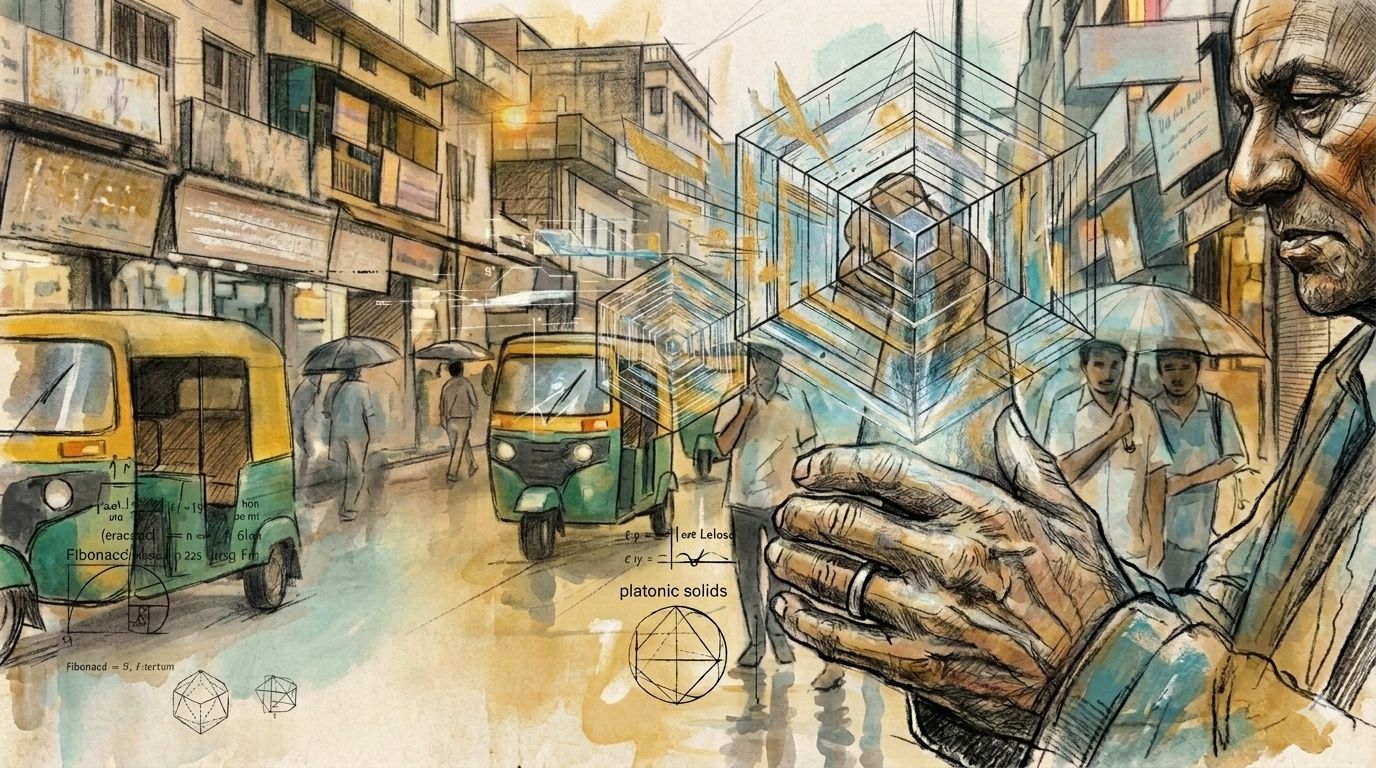
The price of promise: Is trust fading in everyday lives?

Trust really collapses at times in spectacular ways. It is not something that’ll come up and announce itself through betrayal, scandal, or any form of open deception. Instead, it thinks quietly within the unnoticed routine of our everyday life- in small exchanges between strangers, some small, brief moments of promises that were made in passing, some gestures that can really carry a quiet expectation in return. Maybe these are the last resort as an invisible thread that holds social life together, yet increasingly, they seem fragile.
A few weeks ago, I walked to a small book shop near my college looking for an academic book. Just like the other nooks of College Street, books were stacked everywhere— on shelves, on tables, and even on slightly unstable towers of the floor. Dust accumulated in thin layers around the edges of tiles that seemed to have waited there for years. The shopkeeper with patient eyes appeared to know the geography of that chaos quite intimately.
When I mentioned the book I was searching for, he paused for a moment, searching through what felt like an invisible catalogue in his head, and then finally he shook his head gently. He did not have it in stock. But he could arrange for it.
He pulled out a worn notebook that looked older with a reddish tint, more rusted than iron, and asked me to write down the title. After I did, he tore a small slip of paper from the edge of the notebook and wrote down his phone number. Handing it to me, he said with a broad smile, “Please come and buy the book, here’s my contact number, I will call you once it arrives”.
It was a simple sentence, but it carried something heavier than a business transaction. Neither did I make any advance payment; there was no formal order, and no receipt was generated. It was a small gesture of faith, the assumption that if he took the trouble of procuring the book, I would surely return to collect it.
I nodded, took the paper, and left the shop.
While scrolling online, I casually searched for the same book. Not only was it available, but it was also significantly cheaper.
The decision took less than a minute.
Three days later, the book arrived, neatly packaged in a cardboard box, delivered very efficiently at my doorstep. The transaction had worked perfectly. It was convenient, faster and economically sensible.
Yet something about the experience felt incomplete.
When I later passed by the shop, I felt a faint hesitation about entering the shop or crossing by it again.
Nothing dramatic happened. There had been no argument, no selection of cancellation policy, no accusation, only a small promise that quietly dissolved.
Technically, nothing about what I did was wrong. The modern marketplace does encourage precisely this behaviour, where I sit comparing prices and choose convenience, prioritizing efficiency. In fact, in the world that is getting shaped by digital economies, loyalty is often yielding to accessibility.
The technological framework suits the language of trust. It is like a long-lost jigsaw puzzle, hunting after, fitting into the contemporary block of broader society. We are constantly being told to verify whether websites are secure, whether platforms are trusted, whether transactions are protected, whether messages are encrypted, whether two-factor authentication is used, and whether the cybersecurity certificates are valid. It has become something regulated, measurable, and encoded within the system.
But this technological motion of trust only addresses one half of the problem.
Who monitors trust in everyday human interactions?
There is no legal structure or institutional mechanism that can ensure that I will return to the book shop after ‘giving my word’. Because there is no such policy that governs the informal promises people make in daily conversation and life. Instead, this survives through something that is less tangible: social habits, psychological tendencies of human beings to believe in one, and the moral expectation that builds from these.
Trust, unlike law, is not enforced. It gets simply pulled and extended.
I was reminded of this again during a bus ride while returning from my college one evening. The conductor was making his way through the crowded aisle, asking passengers to show their tickets. When he reached an elderly woman, she calmly asked him to come back later. She was looking for a change or adjusting her back because she was carrying a stick with her; it seemed like a harmless request.
The conductor nodded and moved forward to check the rest of the bus.
But before he could return to her, the bus reached the stop. The woman quietly stepped down and walked away.
The conduct said that he had trusted her the way one would trust a mother.
Again, the moment passed quickly, no one argued, no one chased after her. The bus continued along its route.
The cost of the ticket was insignificant. What seemed to hurt the conductor was not the small financial loss of 10 or 15 rupees but the emotional rupture that got embedded in that particular moment. His expectation had been simple: that the elderly passenger would look for the change and then call for him to get hold of the ticket, but not deceive him.
The disappointment felt strangely personal.
Perhaps this is how trust is slowly eroding and taking place with the actions that one has to be bound to after the failed non-cumbersome exchange. Each small incident teaches people to hesitate a little more, verify a little sooner, and doubt a little earlier.
The shopkeeper might now ask customers to make an advance payment before he goes off to collect the books which are not in stock, and the conductor might insist that the passengers buy the tickets immediately instead of returning later.
On the other hand, something else continues to persist.
Despite these experiences, people still extend trust.
The shopkeeper continues to extend his red, torn page of the notebook with his contact number written on it. The conductor will likely believe the next passenger who asks him to return later, because he could read from her face that the child did not have the change for the ticket.
Who calls this system a fragile act of belief?
Of course, it might be weakening in everyday life and filling in with the lost jargon of, in small placards hung in front of the shops- “No exchange”, also something far more stubborn. But it is also rooted deeply within human psychology. Even when experiencing otherwise, we continue to extend small gestures of faith to strangers.
Therefore, the real question is whether a human is slowly learning to withhold trust, or are we just simply holding on to the last fragile string because we are unwilling to let it go?



 Login
Login