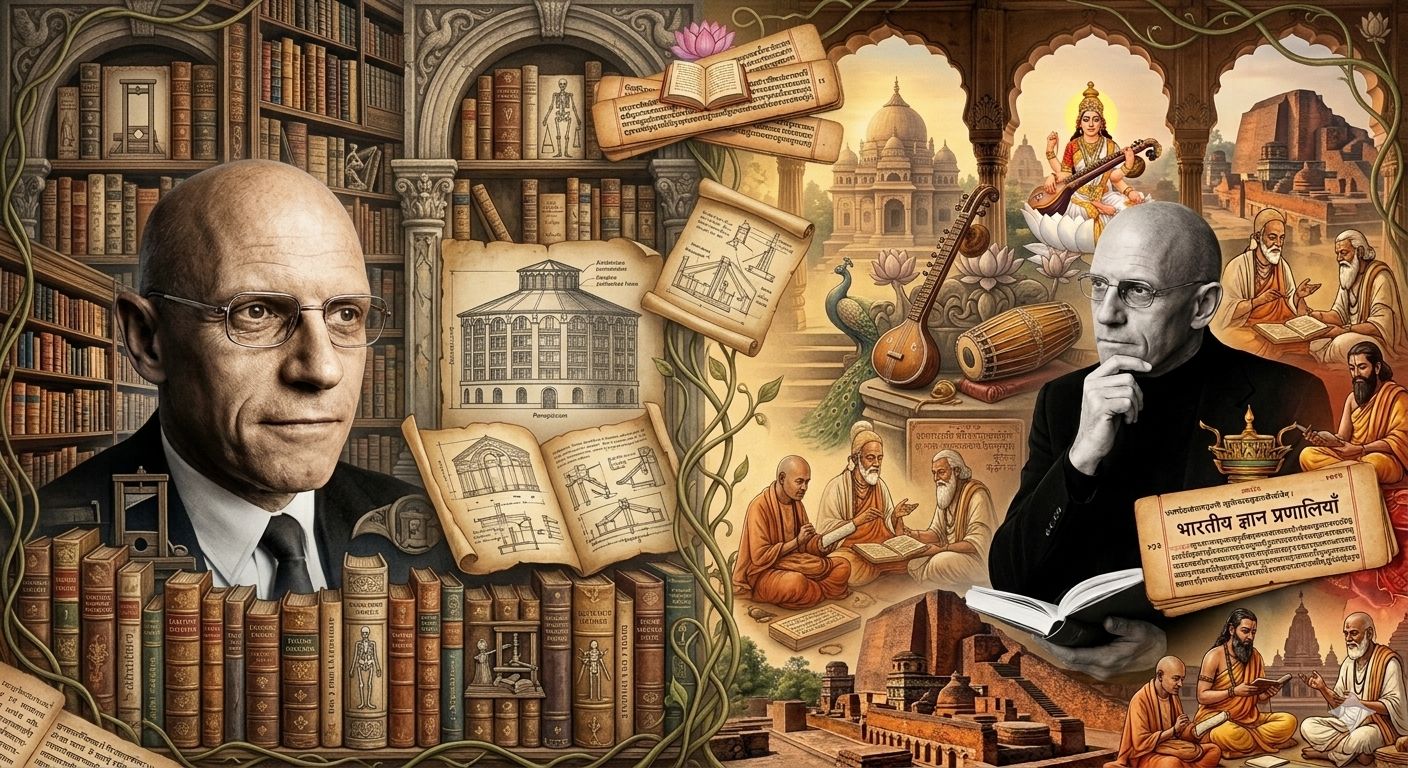
Foucault @ 100: Interrogating the ‘Indian’ in the Indian Knowledge Systems
Supratim is a Political Science student at St. Xavier’s College (Autonomous), Kolkata. He holds interest in critical theories and post-colonialism.
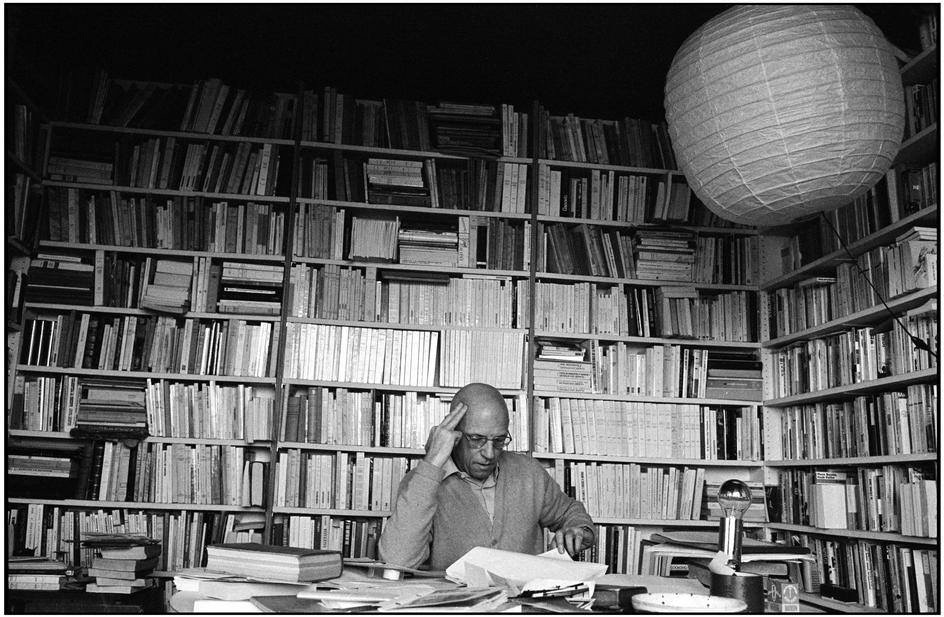
The centenary of Michel Foucault (1926-1984) provides us with an opportune moment to revisit one of his timeless contributions to modern critical theories- the intricate relationship between power and knowledge, and how each constitutes and reinforces the other. Much like Karl Marx, Foucault did not merely offer new answers but compelled us to ask questions differently. Foucault saw knowledge as shaped by power relations in the socio-political arena, and hence it is not neutral. This also implies that ‘knowledge’ changes with the shift or alteration of the existing power relations. Foucault famously called this knowledge the ‘regimes of truth’ that determine what counts as legitimate knowledge, who is authorised to produce it, and how it is disseminated. (Lorenzini:, 2015) Thus, for Foucault:
“… No body of knowledge can be formed without a system of communications, records, accumulation and displacement which is in itself a form of power and which is linked, in its existence and functioning, to the other forms of power. Conversely, no power can be exercised without the extraction, appropriation, distribution or retention of knowledge.” (Sheridan, 1980)
As knowledge is inescapable from power, every attempt to define, organise, and disseminate knowledge must be understood as an exercise of power. This is where the current debates surrounding the Indian Knowledge Systems (IKS) come into analysis along the Foucauldian lines of power/knowledge. While it will be simply wrong to say that the previous governments had allowed knowledge to remain autonomous since education in India was always used as an extended ideological arm of the political authority, the IKS emerges in a time when the Indian society has been deeply polarised by various Hindu nationalist organisations and political formations over public discourse, state institutions, and educational policy (Jaffrelot, 2007). Similarly, education has been employed as the ideological arm in grooming the children with Hindu nationalist ideals, contrary to the secular-progressive path the previous governments had generally endorsed. This can be very well implied with the number of reforms in the Central Board of Secondary Education’s (CBSE) social science syllabus, which allegedly removed any information contradictory to Hindu nationalist narratives, much before IKS was introduced. (Kaul, 2025)
Within this deeply polarised Indian society, along with the exclusionary politics of the ruling Hindu nationalist dispensation, the central question remains: who is the “Indian” in IKS? The crucial question is not whether a particular body of knowledge is true or false, but how it comes to be recognised as truth in the first place. What institutional mechanisms authorise it? Which actors are empowered to speak on its behalf? And which alternative forms of knowledge are excluded from the domain of legitimate knowledge? Foucault has a lot to say.
To begin with, the “Indian” has largely been a colonial construct, far from being self-evident (Chatterjee, 1994). It is neither timeless nor politically neutral. Older being a civilisation than a nation-state, characterising “India” will be to talk about its plurality- linguistic, cultural, religious, as well as intellectual. While Swapan Dasgupta (2019) argues that India’s communitarian nature renders liberalism a “superficial” import, Amartya Sen (2005) provides a nuanced counter-argument. In The Argumentative Indian, Sen contends that even if liberalism did not exist as a codified doctrine, it has always thrived in practice through India’s deeply rooted tradition of public debate and intellectual pluralism. It existed in the Hindu gurukuls, the Buddhist kutagarashalas, the Sufi khanqahs, and even in the royal monarch courts, including the andaruns of the Mughal dynasty. Within this plurality of traditions testified by history, the Hindu nationalist urge of Hindu exceptionalism has essentially streamlined and singularised the “Indian” in the IKS, involving a process of selection, classification, and exclusion.
Foucault becomes handy at this very stage. He refused to use the term ‘power’ as something pejorative – signifying oppression, terror, repression, censorship, etc. Rather for him, power is a productive force (Foucault, 1995). It determines not only what is forbidden, but also who can be seen, heard, and accepted. Power, therefore, legitimises the knowledge- often a singular version. In this process, the ‘truth’ is manufactured, which not only is born from power but helps to sustain itself. If the ‘truth’ is manufactured, and then streamlined and singularised, what does the IKS, acting as the ‘regime of truth’, leave out or silence out? How did power construct the ‘Indian’ in the IKS?
Let us start with what gets excluded. Foucault repeatedly reminded us that every discourse is structured as much by its silences as by its proclamations. Every ‘regime of truth’ constructs boundaries around what can be legitimately spoken, taught, and remembered. Power decides what the population needs to know and what it needs to forget. Consequently, the question of the IKS is inseparable from the question of who is represented by it. Which tradition is granted visibility as the “Indian knowledge,” and which one remains out of its epistemic boundaries?
At the initial glance, the IKS may present itself as an inclusive recovery of India’s civilisational ethos. Yet, this very act of singularising the “Indian” is deceiving its historically diverse intellectual traditions. Knowledge in pre-modern India was not only shaped by a singular religion or a culture surrounding it, but also through exchanges, interactions, conflicts, and even imperial wars. Knowledge was shaped by both hegemonic (Brahmanical) and counter-hegemonic (non-Brahmanical) discourses, and a dialectical interaction between them created different arenas of knowledge systems, influenced by Buddhist, Jain, Dravidian and Islamic intellectual currents, and countless vernacular traditions. To speak of the “Indian”, thus, itself becomes a process of selection through this certain tradition that comes to represent the whole. This process of selection is not very unnatural for Foucault, as the knowledge system sustains itself through classification. But the main issue lies in who possesses the authority to classify the knowledge. Being deeply influenced by the Hindu nationalist understanding of nationhood, the category of the “Indian” often appears to be articulated through a predominantly Sanskrit and Brahmanical lens. (Gohain, 2025)
Therefore, the provided prominence to Vedic sciences, Hindu philosophy, and Sanskrit literature is neither a coincidence nor an accident. These are presented not as one of the many important facets of Indian intellectual history, but rather treated as the foundational core of the Indian civilisation itself. Within this process, what emerges is not a recovery of knowledge but a construction of a hierarchy of the knowledge in which some traditions are rendered the utmost importance, while some are rendered peripheral and supplementary.
A Foucauldian reading, therefore, would engage us with the silences the IKS has produced. It will compel us to interrogate the peripheries of the IKS. Where, for instance, do the intellectual traditions of the heterodox (nastika) schools of thought like the Ajivikas and Caravakas, or of the anti-caste intellectuals like Phule, Ambedkar, Periyar, and Narayana Guru fit? While they provided critiques of social hierarchy and produced an alternative vision of power, reason, and knowledge rooted in emancipation, these traditions occupy a peripheral position in the IKS. In addition, centuries of Islamic presence and the intellectual traditions influenced by it, including its contributions to developments in philosophy, astrology, mathematics, medicine, literature, and political thought, are often treated as mere ‘externals’ rather than constitutive elements of Indian civilisation. This also reveals the question is not only about knowledge, but also about belonging. Which community is treated as the authentic participants in the making of India, and which communities are positioned at the margins?
This brings us back to the question of who is the “Indian” in the IKS? The category appears universal, but its construction reflects the priorities of the dominant socio-political groups. Foucault reminds us that universality is the language through which particularities speak. What claims to represent everyone is in practice the representation of a particular historic moment, which has won the legitimacy of the authority to speak on behalf of the whole.
The irony is a project ostensibly committed to decolonisation may inadvertently reproduce another form of epistemic domination, reflecting the same colonial knowledge systems which legitimised one and delegitimised the other. If IKS is to move beyond the ‘regime of truth’, it must accept the plurality of cooperative and conflictious intellectual traditions. It is to move “from the Indian Knowledge System to the Plural Knowledge Systems of India” (Dey & Sen, 2026), remaining open to the multiplicity of traditions that have historically shaped the Indian experience.
Foucault’s centenary, thus, has provided us with more than a grand opportunity to celebrate one of the greatest thinkers of the 20th century. His theories have provided us with an interrogative lens through which a new intellectual tradition – the IKS has been constructed by the simultaneous creation of the ‘regime of truth’. The suggestion is not to reject the Indian knowledge, but to address the diversity and plurality of it. It is by accepting that the “Indian” is not a monolith, and that every tradition had its own part to play in the making of India. It is suggested that the colonial knowledge system is not replaced by an indigenous form of dominant knowledge system.
References
- Lorenzini:, D. (2015). What is a “Regime of truth”? Le Foucaldien. https://doi.org/10.16995/lefou.2
- Jaffrelot, C. (2007). Hindu nationalism: A Reader. Princeton University Press.
- Sheridan, A. (1980). Michel Foucault: The genealogy of power.
- Kaul, V. (2025, May 9). NCERT Erases Mughals, Delhi Sultanate: History or Hindutva? Frontline. https://frontline.thehindu.com/the-nation/education/ncert-textbook-controversy-medieval-history-omission-nep-2020/article69556504.ece
- Chatterjee, P. (1994). The nation and its fragments: Colonial and Postcolonial Histories.
- Foucault, M. (1995). Discipline and Punish: The Birth of the Prison. Vintage.
- Dasgupta, S. (2019, June 19). What elements does India’s nationalist conservative politics draw from its counterparts in the West? Scroll.in. https://scroll.in/article/927420/what-elements-does-indias-nationalist-conservative-politics-draw-from-its-counterparts-in-the-west
- Dey, S., & Sen, R. (2026). From the Indian knowledge system to the plural knowledge systems of India. Public Humanities., 2. https://doi.org/10.1017/pub.2026.10173
- Gohain, H. (2025, March 3). The question of ‘Indian knowledge System. Counter Currents. https://countercurrents.org/2025/03/the-question-of-indian-knowledge-system/




 Login
Login