
Shashi Tharoor’s Stalemate

Srinath Rao P is the Founding Editor of The ArmChair Journal. He is currently at the University of Chicago and is an alumnus of IIT Madras, Ashoka University, Rishihood University, and Purdue University.
A four-time member of the Indian parliament, Shashi Tharoor does not need any introduction. The first and only time I saw Tharoor was around 2017. Tharoor was supposed to address the students at Hyderabad Central University at the behest of the NSUI, the student wing of the Indian National Congress. The central government’s approach towards universities was the main theme after the Rohit Vemula incident.
As is normal for students to wait ahead of big talks, students are also not bothered about waiting much, especially for a speaker with Tharoor’s popularity, as long as he comes. Tharoor too arrived a half an hour or so late to the venue. Speakers generally blame the traffic and move on.
However, as he walked onto the stage, Tharoor did not go to the podium or to the chairs arranged to sit. He walked towards the students to the center of the front edge of the stage and with his hands in Namaste, he said, “My sincere apologies for being late.”
His friendly and reassuring voice took control of the hall, presence was felt and students felt anchored. His INC kanduva (gamcha) made him look political and his apology made him look diplomatic.
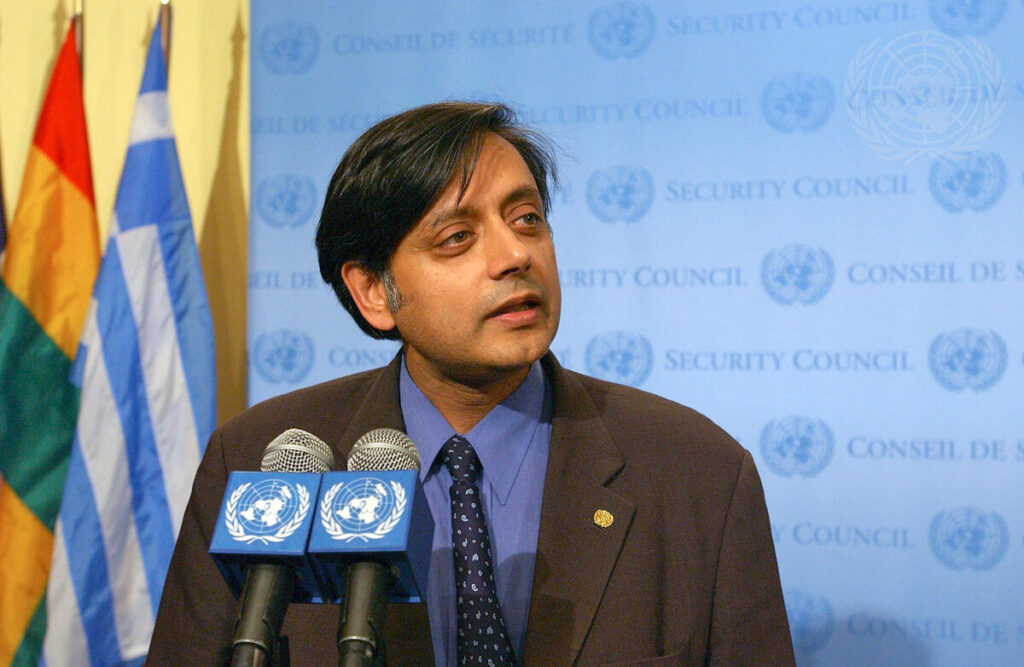
Shashi Tharoor appeared to gel with the qualities that intellectual elites in the Indian National Congress possessed when he contested first around 2009. A foreign degree, excellent English, leadership roles at the United Nations, global network and an authorship on books. A stellar background of qualifications and a profile envied equally by academicians, bureaucrats, intellectuals and public affairs professionals.
With ideological synchrony, and a practical party presence in the state where he comes from (Kerala), the Indian National Congress (INC) also appears to be a natural choice in case he had aspirations to be in the Indian parliament. For the INC, in case there are no particular local factors to be concerned about, Tharoor’s presence is also a value addition right at the top. In fact, not just a party ticket, he was also successful in being part of the council of ministers during the last term of INC led UPA between 2009-14, though he was a first time member of the parliament.
As it stands, Tharoor may not be a mass leader. But he is a leader of great personal influence. So, where Tharoor stands is not a matter of insignificance.
Tharoor as a Liberal Hindu
The 2014 debacle also was accompanied by an intellectual and leadership vacuum in the INC. Especially in the face of a popular leader like Narendra Modi and the ideological force of Hindutva, INC lacked both the leadership who had credibility among people and also the counter they could offer to Hindutva.
INC lacked a framework to think as the older versions developed against foreign rule or how a new India can be built are not irrelevant, but had a difference in context and can’t be directly used to counter the new force. The party needed innovation and intellectual enrichment to effectively counter the new politics of BJP.
On the other hand, BJP looked well prepared in terms of their thorough visit on many fronts. INC’s criticism that BJP was politicizing Hinduism lacked credibility, or turning India into a dictatorship could not counter the need for decisive leadership. Issues of misgovernance did not matter enough for the public to take note. Even something like demonetization did not help the INC much, despite the topic being a common talking point. How and whether BJP worsened the lives of common people was not clear. BJP’s vision was much ahead and larger than INC’s criticism.
When you counter something on its own terms, the counter can be the strongest. It significantly lowers the credibility of the other side. An example case is when someone, in defence of the BJP, uses Emergency or how frequently the President’s Rule was imposed on states under the INC regime – to counter arguments on misuse of power by the BJP.
While this is just an example, the counter gets even more substantive when you hit the core arguments of the other side. ‘Purva Paksha’ offers such an opportunity to engage with the other side better. When you can counter a school of thought at the core of its existence and assumptions, it can open up a whole new set of possibilities for communication. Any party’s communication can take a new life if such areas are identified. This is true for both academics and politics. BJP was well prepared on this front. Too quickly after coming to power, launching a decisive Swachh Bharat campaign co-opting Mahatma Gandhi was a demonstration of this preparedness.
INC needed such a framework to tackle the new lines of communication of BJP. What Tharoor aimed to do in his recent works is to provide these intellectual frameworks, building on existing liberal frameworks, as an opportunity for the INC to build its counters on.
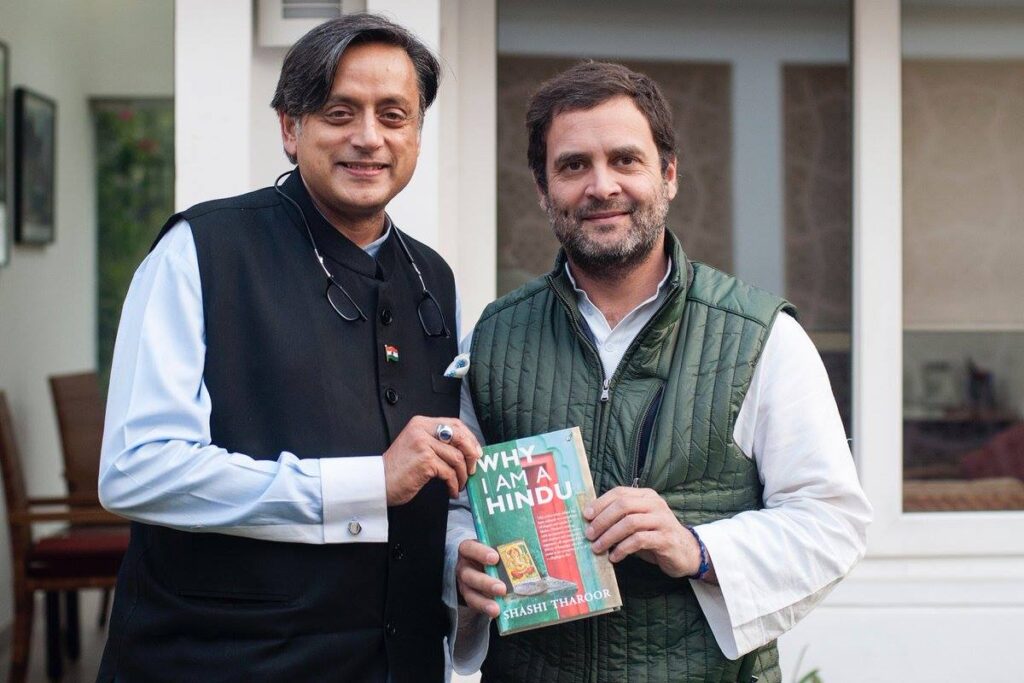
So, Tharoor’s value addition in the opposition is both his ability to produce new intellectual works, while also being an excellent communicator at propagating them personally. For example, Tharoor’s ‘Why I am a Hindu’ can serve towards co-opting Hinduism for the INC, and also distancing Hindutva from Hindus. Just for comparison, this is more substantive than how BJP co-opted Mahatma Gandhi with the ‘Swachh Bharat’ campaign. The former had more intellectual justification. Another book – ‘The Paradoxical Prime Minister’ is also right on point on this matter. However, intellectual works don’t have relevance until they are communicated properly.
Towards taking ideas to India’s English masses, it is needless to justify Tharoor’s communication capabilities in this essay. The simplicity and grace with which he addressed British halls in the Oxford Union debate on colonial reparations British owes India, turns every believer into a skeptic, and every skeptic into a believer. Considering his capabilities to go viral, he is also an asset to any TV, or social media channels. Not just at personal capacity, these ideas needed to be picked up with the whole party ecosystem for further propagation, for the greatest benefit to both Tharoor and INC.
However, the coordination between Tharoor and INC did not turn mutually beneficial, or the party did not make use of him as it should have. Far from coordination, the party and the individual seem to share a more neutral relationship. While outsiders cannot comment on relationships, some structural reasons can be identified that can destabilize relationships.
Diplomacy that distances
In criticism, opposition parties have a vested interest. Lacking power for themselves, criticism always conflicts with the desire to grab power. Every opposition party has to overcome this perception in order to credibly challenge the ruling party. So, building credibility is as much a matter of political strategy, as much as the strength of criticism.
Praise offers an opportunity in building this credibility. In praise, political opponents do not face this conflict. Praise across opposing party members appears more authentic than criticism. However, a day’s praise could nullify months of criticism, for the mere reason of authenticity. Additionally, praise can improve the credibility of the person who praises, as the person appears to go beyond vested interests.
While yielding on less effective points and building credibility, the critic can raise more pertinent points strategically. But the risk with praising political opponents is that it strengthens the opponent. So, a critic has a trade-off between temporarily strengthening the opponent to build credibility and preserving it to use later, to strengthen one’s own future criticism of the opponent.
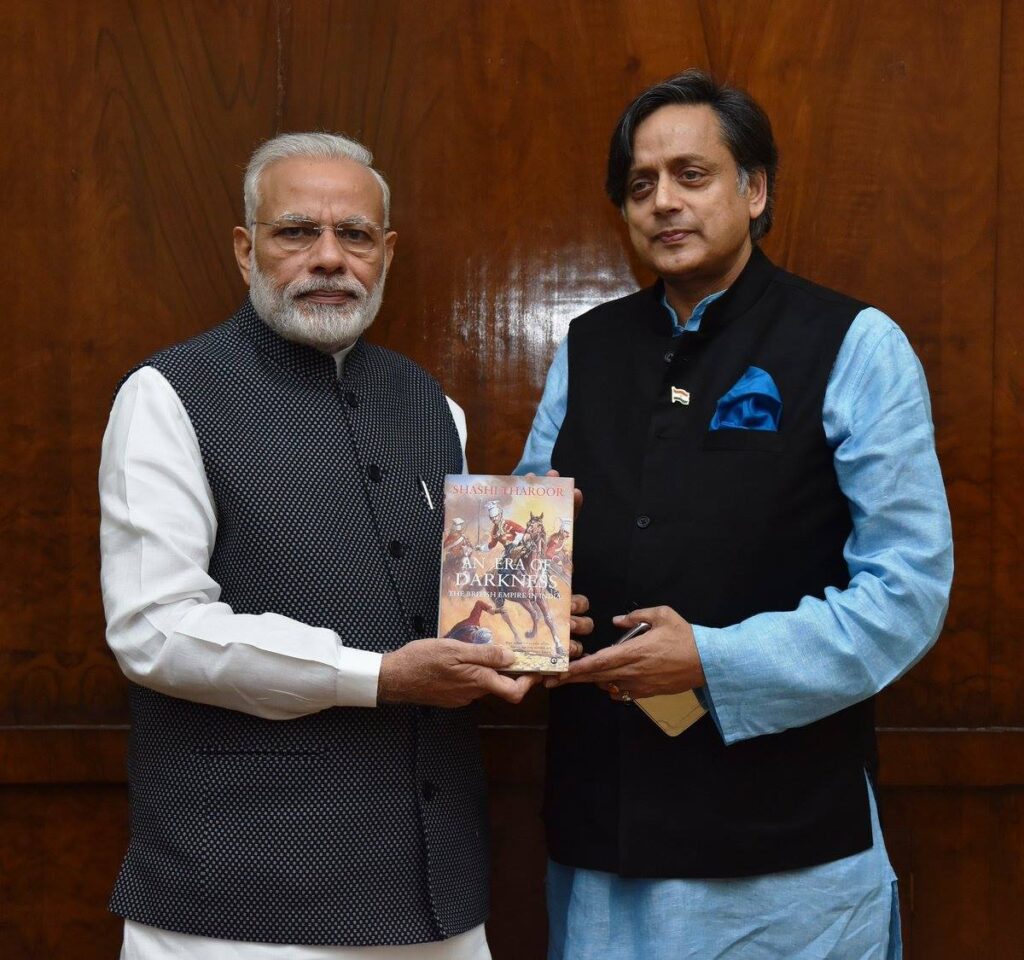
Shashi Tharoor’s positive expression for the Modi government during its first term appears interesting for this reason that it can make the opposition party credible. This is also similar to the recent meeting of Donald Trump and Zohran Mamdani in the United States, where Trump mentioned that he does not mind Mamdani calling him a fascist. While Trump could project that everyone should work together for national good, it also means that Mamdani is too little for him to mind – irrespective of what he said about Trump. Through his acceptance, Trump becomes the bigger man with more credibility.
However, executing this adds challenges as it requires a coordinated effort with perception management across party leadership, colleagues, supporters, and even the political opponents. It ultimately boils down to the risk the key stakeholders can handle, to execute the same. A secure system can handle more risk. Risk appetite also depends on the player’s offer of security to stakeholders. Nevertheless, Shashi Tharoor was stopped from being a party spokesperson, displaying that the party does not want to take any risks.
With friends across aisles, Tharoor’s diplomacy can strengthen this risk perception within the party. In times when political targeting is the norm, Tharoor managed to clear himself off controversies and also stayed in the good books of the BJP.
On matters of external affairs, BJP has been downplaying Rahul Gandhi (the Leader of Opposition in the Parliament) by allowing limelight onto Shashi Tharoor. While Shashi Tharoor led the vital all party delegation to the US and closer countries after Operation Sindoor, he also justified his selection by securing a diplomatic victory with Colombia, in national service. Tharoor was also invited to the state dinner with Putin, with apparently no invitation to Rahul Gandhi. Tharoor’s personal capabilities can’t be discredited.
More and more attention from BJP means more and more limelight for Tharoor – means more personal influence – means more difficulty for the INC to deal with him. Shashi Tharoor’s acceptance of these opportunities means he is not selfless in his pursuits – that he is not willing to keep the party above him. He has chosen to keep the BJP as an outside option to better negotiate within the INC, if at all he intended to.
Setting the stage
Tharoor may not be a mass leader who can drift a vote bank in his direction. However, a 19% vote share for the NDA in 2024 general elections in Kerala is tempting for any party to consolidate. Considering traditional loyalties and local issues dominating in state election, it may not be possible to convert all those who voted for the NDA in 2024 general elections in Kerala to vote for the BJP in the assembly elections 2026. Nevertheless, it is definitely not a bad idea to expect an INC leader and a parliamentarian to be a familiar face for those 19% voters. So, the BJP could only gain by luring Shashi Tharoor to influence the assembly elections as much as possible.
Additionally, the autonomy of Shashi Tharoor is the autonomy that a liberal proposes to oneself when one also chooses to hold liberal values. So, hypothetically speaking, a party that wants to credibly champion liberal values cannot go against a member who practises it.
The burden of this challenge is more on parties that pitch liberal values than those that don’t. While this demands that the party should be comfortable with members holding autonomous positions, it also means they risk lacking a coherent stand. It also means Tharoor can disagree with INC’s own conduct in the parliament. It can also mean Tharoor can also second the prime minister’s speech on education reforms.
In an ideal case, if we expect all the opposition party members to take the party line in criticizing BJP, let’s assume the effect of this is positive (gain) on the opposition party, positive on the member (gain) who does the criticism, and negative on the ruling party (loss).
The current state of affairs is that the member has a positive effect (gain) as he has more outside options in a situation where he deviates from the party line. Additionally, the ruling party is benefitted positively (gain) because of this strategic coordination. The opposition party sees a negative effect on itself (loss).
For the BJP, the intent in ‘poaching’ or luring Tharoor is that the BJP can act in a manner to maximize loss to the INC. While the BJP may not be particularly confident in Tharoor adding value to the BJP itself, Tharoor leaving the INC can pose a definite loss to the INC at the least.
Whether BJP offers larger plans for Tharoor in the Kerala state elections is not a case to be credibly engaged at this stage, the following analysis does not change even if such a scenario is substituted to the benefit that Tharoor would receive for a defection.
The inevitable Stalemate
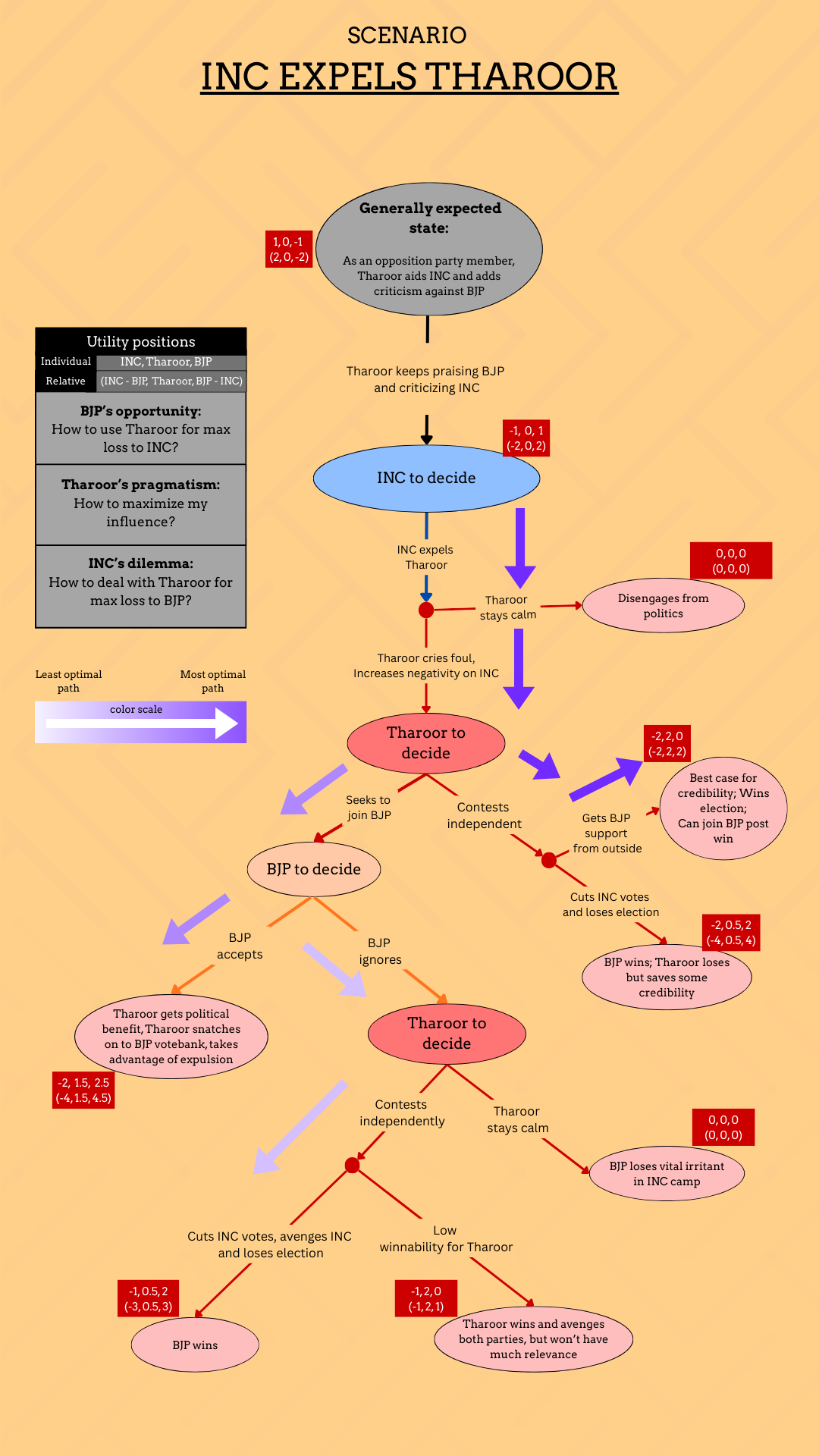
Following flow charts demonstrate two scenarios: First, when INC does not act vis-a-vis Tharoor and second, when INC expels Tharoor.
Since there are many sequences of decisions possible, current state where Tharoor praises BJP and criticises INC is modelled as the baseline. Decision of these players: INC, Tharoor and BJP can enhance or reduce one’s posture vis-a-vis others. Since benefit of a party can mean deficiency for the other, relative gain/loss are considered in finding the optimal path in which decisions could take.
The next political event could be the Kerala assembly elections in 2026, or even a cabinet reshuffle of the NDA government.
When INC expels Tharoor, it is easier for Tharoor to cry foul. His credibility will not be damaged much. The best case response for him would be to stay independent till the next political event and wage a coordinated attack on INC with the help of BJP. In such a case, Tharoor also has a reason to avenge his ouster from INC. Staying independent preserves his credibility and also makes criticism on INC most effective. However, the collective impact of coordination would be limited. For example, if Tharoor is expelled before the assembly elections and he chooses to stay independent, he might help a little to add negativity on INC – but may not be able to nudge a conviction to vote for the BJP.
However, in case Tharoor joins the BJP on the pretext of expulsion, Tharoor can strengthen BJP’s attack on the INC. The collective impact of Tharoor and BJP could be more damaging to the INC, though it could come at a slight cost of personal credibility to Tharoor. In such a case, Tharoor would be favouring the BJP as he puts his credibility at stake. In case, this attack is launched for the Kerala assembly elections, Tharoor can also be rewarded with a cabinet reshuffle sometime after the elections, irrespective of the performance of BJP in the assembly elections. BJP will want to definitely take such a risk.
So, the main goal of INC may be to prevent this coordinated attack. So, in no situation, will the INC afford to expel Tharoor. However, to make the expulsion more and more possible, Tharoor will have to intensify his internal criticism on INC. In such a scenario, INC can also turn a crisis into opportunity to point out the coordinated effort and play a victim card. The more Tharoor criticizes, the more INC can play the victim card – thereby reducing the credibility of Tharoor without expulsion.
Avoiding a zero sum game
Intellectual versatility and diplomatic capability means Tharoor can add value to the BJP as well. It may also be a worthwhile idea to observe how much push BJP can achieve for the Kerala assembly elections.
While for the BJP, the Kerala election may be an experiment, for Shashi Tharoor it could be a risk. In a state like Kerala, a more liberal Hindu like Tharoor could even be a better candidate than a hardliner. His criticism of the INC will also be more authentic and effective as he knows the internal affairs of the INC better.
If we assume that Tharoor’s expulsion from the INC does not happen as INC wants to avoid further loss, the next possibility for Tharoor is to leave the INC on his own after waiting for a reasonable amount of time while criticising the party from within.
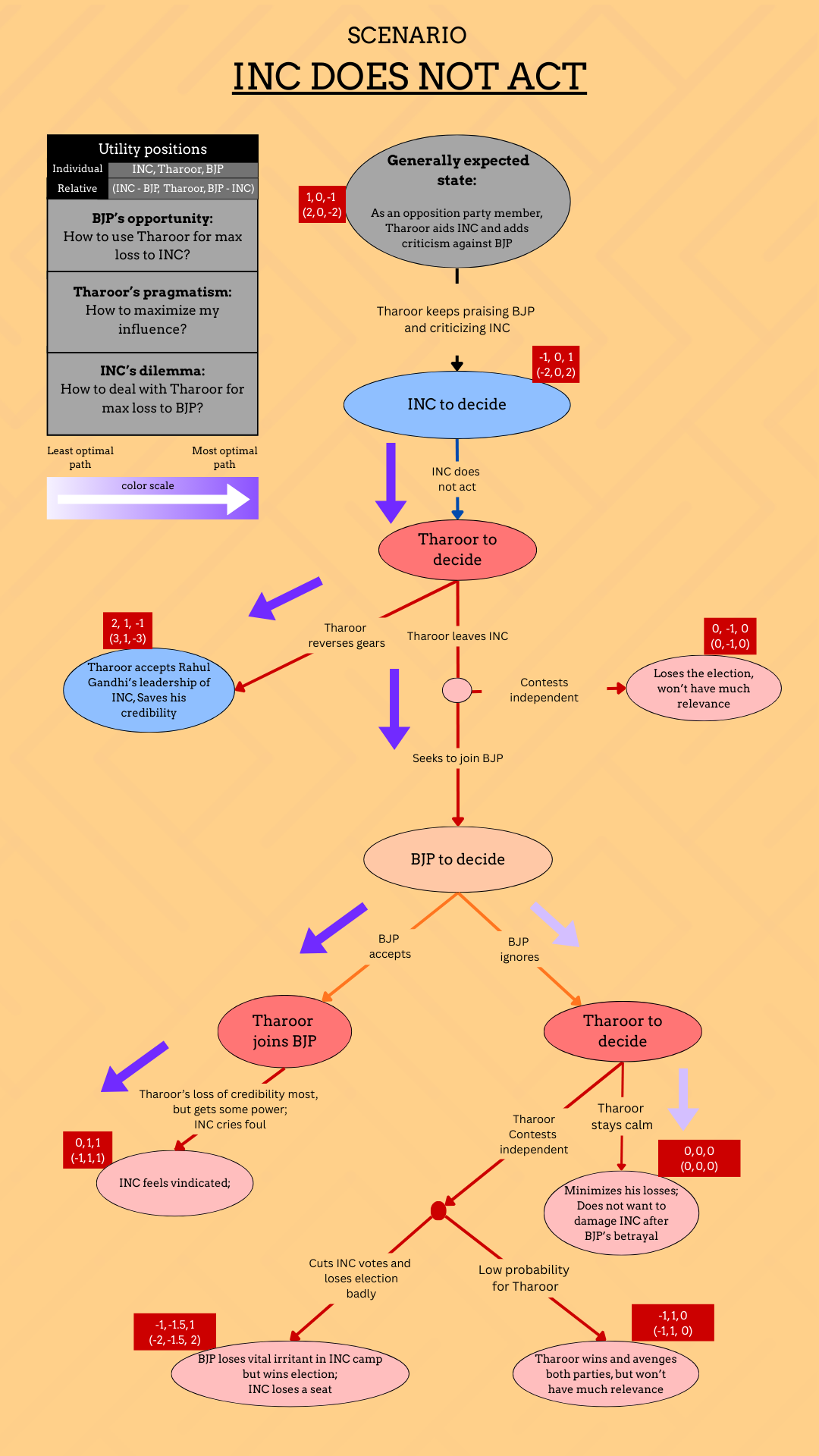
In such a scenario, the returns may not be that great for Tharoor to risk his credibility built over more than a decade. For the BJP too, a Tharoor with more credibility can help be a legitimate irritant inside INC camp, than a Tharoor in their own party, but with no credibility.
Credibility is a vital variable while discussing party affiliations of intellectuals more than the party affiliations of mass leaders. For example, It may fine if a leader with a caste base drifts between parties for practical reasons. But for intellectuals, defections can’t be justified on being pragmatic. Probably leaving parties can be justified for differences in ideas – but not choosing another party with a different set of ideas.
If INC nullifies Tharoor’s criticism with patience without expelling him from the party, it means Tharoor would have lost credibility and may not get an INC ticket in the next election – where he could contest on a BJP ticket. This is probably the most effective scenario to benefit Tharoor and BJP, wherein Tharoor continues to be an INC member and criticizes the INC till a point where INC to make a decision.
So, the current stalemate could be the equilibrium for all three actors. This equilibrium means, even during the Kerala assembly elections, INC will have to face a Tharoor who is inside the party.
The fight could be interesting!
But in case the stalemate has to be escaped, it can only happen with a re-negotiation between the INC and Tharoor towards a more symbiotic relationship, while the BJP shall aim to preserve the equilibrium.
This article is primarily written for analytical purposes, and not to influence any stakeholder discussed. Any comments are welcome.
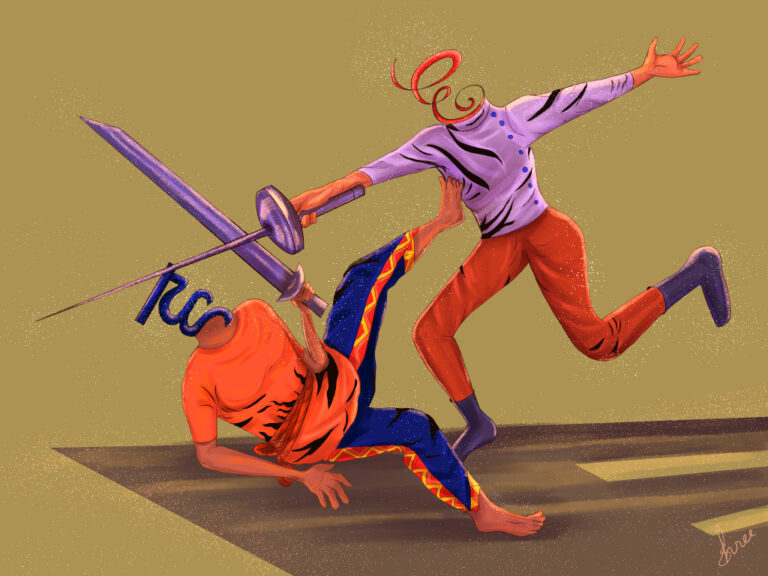
Featured Image credits: Parnoshree
I thank my friends Siddhartha Thota, Manoharan S S, Ambar Ghosh, Amritha Varshini and Deepak Kumar for sharing thoughts on the topic.
 Login
Login