
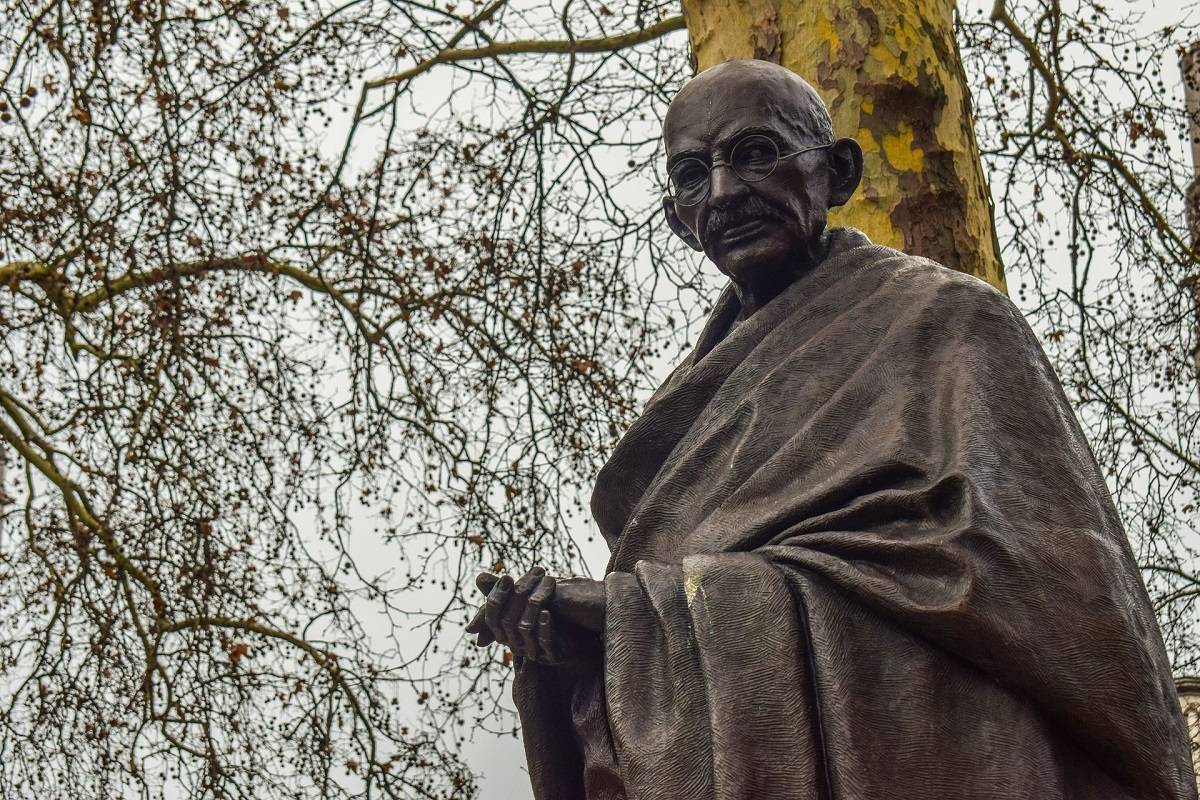
Re-imagining Environmental Sustainability through Gandhian Philosophy

Sunaina Sabat is an undergraduate student pursuing BA (H) Political Science Hons at the University of Delhi.
[responsivevoice_button voice=”US English Female” buttontext=”Read out this Theel for me”]
The earth, the air, the land and the water are not an inheritance from our forefathers but on loan from our children. So we have to hand over them at least as it has been handed over to us. There is a sufficiency in the world for man’s need but not for man’s greed.
Mahatma Gandhi
This utterly reflective quote by Mahatma Gandhi, one of the greatest leaders of the Indian Nationalist movement, depicts his sincere concern for Mother Nature, while ardently advancing his principle of non-violence. It’s intriguing to note that, besides inspiring countless non-violent protests all around the world, Gandhi had also been aware of the consequences of ruthless human practices against the environment.
As our nation as well as different countries all around the globe celebrate Gandhi’s 151st Birth Anniversary amidst the Covid 19 pandemic, his eleven Vows or Vratsa namely Non-violence, Truth, Non-stealing, Brahmacharya, Non-avarice, Physical labour, Control of Palette, Religious harmony, Fearlessness, Swadeshi and Abolition of Untouchability ought to be commemorated, along with his unexplored philosophy on the much debated concept of ‘Environmental Sustainability’.
Critic of Industrialization
As early as in 1909, through Hind Swaraj, Gandhi stated that the civilization of the West being welcomed in India in the name of modernity, is the start of a civilization which equates consumerist lifestyle and abundance with development. He distinguished between ‘need’ and ‘want’ of the human being, while emphasizing on the Future Generations as we use natural resources in the present.
Gandhi was against the destructive development model adopted by the West, which resulted in global warming, climate change and much more. He had noted, “God forbid that India should ever take to industrialization after the manner of the West. The economic imperialism of a single tiny island kingdom is today keeping the world in chains. If an entire nation of 300 million took to similar economic exploitation, it would strip the world bare like a locusts.”
Furthermore, in Young India (1920), he wrote thus: “We want to organize our national power not by adopting the best methods of production only, but by the best method of both the production and distribution.” It is clear that Gandhi was not against industrialism, but against its negative impacts namely labours displacement, exploitation, and environmental degradation.
Thus, in contrast to modern civilization that promoted material welfare along with increasing profit motives, Gandhi’s ‘Hind Swaraj’ was against growing consumerism, materialism, and the wrong model of development. He challenged the whole framework of development to promote environmental conservation.
Propagation of Equality and Rural Development
Gandhi epitomized women for their role at various social levels and considered them equal to men in all respects. He “worshipped women as an embodiment of the spirit of service and sacrifice”, which helped them to take up national integration and in a way worked for gender equality. Moreover, his environmentalism was built on ecological practices of tribal and peasant communities in order to keep their identities intact. Gandhi was equally concerned about the liberation of scavengers. He called them ‘Harijans’ (God’s People) because of the great service they rendered to the society, which no one else could fulfil.
Gandhi had once said “The blood of villages is the cement with which the edifice of the city is built.” He wanted a development process which is “harmonious, poverty free, nonviolent and contributes to a self-reliant society.” He envisaged co-existence of steel mills, machine making in cities with handicrafts, cottage industries, animal husbandry, forestry and biomass processing in villages. The concept of self-sufficient village was seen by him as an economy, which allows very small shares of benefits to go out of the village and can be useful to strengthen rural India leading to reduced urbanisation.
Through his village community concepts, he provided some of the most plausible solutions like integration of Khadi industries, Charkha and agriculture to prevent the crisis of unemployment and create more comfortable cities. Gandhi also urged medical practitioners to research medicinal properties of plants, as a means to promote his concept of Swadeshi services for all.
He is criticized for not emphasizing the creation of an institute for practise or science of agriculture and being silent on the practise of shifting cultivation. Yet, it cannot be denied that his idea of rural development was meant to halt migration of villagers as “ecological refugees” to urban cities and thereby maintain an environmental balance.
Promotion of Sustainable Living
Gandhi noted in Harijan, ‘Anyone who fouls the air by spitting about carelessly, throwing refuse and rubbish or otherwise dirtying the ground sins against man and nature. Man’s body is the temple of God. Anyone who fouls the air, which is to enter that temple, desecrates it’. He belongs to the school which believes in remedy rather than cure. He is profounder of a kind of life, culture and society which will never lead to environmental problems. He further advocated a simple and satvik diet to maintain one’s health. He fervently pleaded for vegetarianism and detested meat-eating.
Gandhi was a passionate champion of a life pattern based on three cardinal principles; Simplicity, Slowness and Smallness. In this context, his prescription of “simple living” attempts both to curb human overreaching and greed, and to prevent the mindless exploitation of natural resources. For instance, every day when Gandhi took a bath (1920’s – 1930) in the freely flowing and unpolluted water of the Sabarmati near the Ashram, he consciously used only the minimum requisite water needed for a bath. He and his followers used scrapes of papers for writing notes and reusable envelopes to send letters. Gandhi built his ashrams on waste lands, which were more than often not reptile proof. He used this opportunity to practise ahimsa along with his vision of Sarvodaya, which implies a healthy environment that can be evolved by man to ensure harmonious existence with nature and other living beings.
Gandhi synthesized his philosophical and spiritual principles out of his deep knowledge of the religious traditions of Hinduism, Buddhism, Jainism, Christianity, and Islam. He laid emphasis on cow protection and despised western lifestyle, which had dehumanised man. Notable destinations like the Phoenix settlement and the Tolstoy farms, South Africa are set up on his ideals of simple life. Even Brundtland Commission’s definition of sustainable development is similar to the Gandhian idea of greed-need syndrome.
His concept of ‘respect for nature’, simple living and voluntary reduction of wants has become all the more relevant for India and the world in the present times. According to Pravin Sheth, ‘judicious blending of the greens (in the west) and Gandhi (east), at the level of thought and action, can help to usher us in a post-modern age and post-industrial eco-cultured society’. Gandhi once remarked “My life is my message”. He had indeed championed the cause of disseminating sustainable development and making the entire world understand the importance of practising a lifestyle with minimal impact on our environment.
Inspiration for Environmental Movements and Scholars Globally
The word “ecology” appears nowhere in Gandhi’s writings, and he never spoke about environmental protection as such. Yet, as the Chipko Movement started by Sunderlal Bahuguna (ardent follower of Gandhi), the Narmada Bachao Andolan and in a very different context, the manifesto of the German Greens have shown, the impression of Gandhi’s thinking on ecological movements has been felt widely. Moreover, Kamala Chowdhary has found the reflection of Gandhi’s ideas related to environment in the “Agenda 21”, fashioned by the largest number of nations of the world, at the Earth Summit at Rio-de-Janeiro in 1992.
His close disciple and associate Kaka Kalelkar was in the habit of breaking off an entire twig, merely for four or five neem leaves he needed. When Gandhi saw that, he had said: “This is violence. We should pluck the required number of leaves after offering an apology to the tree for doing so. But you broke off the whole twig, which is wasteful and wrong.” His principles have always struck a chord with all those who have cherished the principles of non-injury, environmental conservation, practised vegetarianism, sustainability or accorded animals the dignity of humans.
It is not surprising therefore, to see Mahatma Gandhi’s quotations being used as campaign headlines by environmental activists worldwide. His quotation, ‘Earth provides enough to satisfy every man’s needs, but not every man’s greed’, has become a global call for sustainability and sustainable development. Kumarappa, an Indian economist concerned with improving the fertility of soil through organic methods, cited ‘economy of permanence’ and sustainable development crouched in Gandhian framework. E. F Schumacher popularised the concept of ‘intermediate technology’ based on Gandhian philosophy. Edward Carpenter and St. Francis of Assisi, patron saint of nature and animals were also inspired by him. Bhikhu Parekh coined the term ‘Cosmo centric anthropology’ for Gandhi’s philosophy of environmental sustainability. The Norwegian philosopher, Arme Naess called his concept of ‘Bio spherical egalitarianism’ inspired from Gandhian philosophy. Vandana Shiva acknowledged his exclusive focus on rural areas and started her project seed sustainability for its better implementation.
Encyclopaedia of human ecology (2003) edited by Julia R miller omitted Gandhi as one of its entries in its otherwise impressive list. But it’s right to proclaim that he may have never used words on environmental protection, but what he did and said made him one. Similarly, V.S. Naipaul criticized Gandhi for what he called “narcissism” on being completely silent on nature in his autobiography and certainly, Gandhi was sparse in his discussion of the relationship of humans with their external environment. Yet, as Pandit Jawaharlal Nehru noted “Though Gandhi wrote no ecological treatise, he made one of his life”.
Contemporary Relevance
Global warming, climate change, deforestation is serious pointers to the existential problems that numerous species of animals, birds and plants are facing today. Urbanisation and toxic waste accumulation has created conditions fatal to the living conditions of humans. The novel Covid 19 pandemic with its uncertainties has posed relentless challenges on the healthcare sectors, environmental activities, mental health, and economies globally. The dire need for a sustainable model of growth and development is more rampant than ever.
As P.N. Haskar, a noted Indian thinker had said: “There is need to reiterate Gandhian values and instead of merely garlanding the portraits of Gandhi, Indians must translate his ideals into real life.” From a Gandhian perspective, sometimes too extreme but free to interpretation, the present environmental crisis is not a disease, but only a symptom. A good doctor treats the disease and not the symptom. The disease is the very concept and patterns of growth and development that are being followed everywhere. If the perspective changes, the disease is diagnosed. Therefore, let us resolve and dedicate ourselves to complete his unfinished goals, wherever we may be and in whatever way we can. Let Gandhi’s memory guide us to the right path of a sustainable and green earth.
Featured Image Credits: Dimitris Vetsikas from Pixabay



 Login
Login
I really felt this was very organized and showed how Indian philosophy has already laid the foundation of sustainable development even before the mainstream media caught up. I hope this makes people more aware and conscious of their actions towards the environment.
Excellent work sunaina . Very informative ?
Excellent and very knowledgeable ?
Very well written!
Excellent.Veryvwell articulated.