

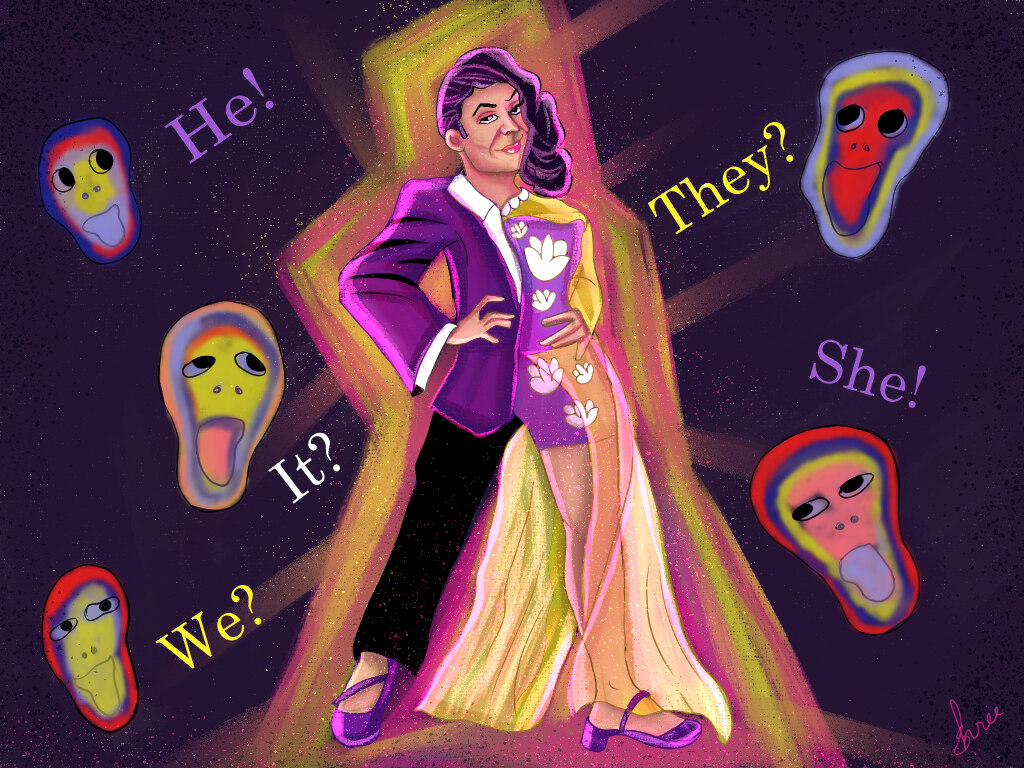
Why pronoun sensitivity is a serious business?

The recently released Season 3 of The Family Man, a widely watched mainstream series, yet again offers its signature mix of espionage, geopolitical intrigue, and middle-class satire. However, just a few minutes into the first episode, it slips into a deeply problematic ‘comedic’ moment: Family man-Master spy Srikant Tiwari is thoroughly bewildered upon learning that his teenage daughter now identifies with they/them pronouns. Fatuous punchlines like “ye ‘they’ log kaha ja rahe hain?” appear to capture ‘harmless’ comedy about an Indian middle-class parent and their confusion with the evolving nature of self-identification of gender and non-binary expression.
The entire scene reduces pronoun sensitivity as something too frivolous and a cultural fad too insignificant for the country’s smartest intelligence agent to grasp. The problem intensifies as the show never revisits the moment. The conversation around the daughter’s pronoun choice is abandoned without reflection. There is no character growth, no narrative integration, and the scene exists solely as a comedic aside.
However, the humour is never innocuous, especially when directed at identities still fighting for recognition. For non-binary teenagers and young adults across India, many of whom already face mockery, erasure, or hostility when expressing their identities, this kind of representation is not trivial. The series is only an entry point to the broader failure of popular culture towards non-binary youths and their choice of expression. When widely influential cultural texts reduce the questions of identity and expression to a fleeting joke, they signal to their millions of viewers that this subject requires no further thought.
Ethics of Recognition
Using correct pronouns is not “fashion”, “too modern”, “unnecessary” or “pretentious” as they are often described. Respecting someone’s chosen pronouns affirms their dignity, but when refused, dismissed as unnecessary or as a fad, it is a direct participation in their marginalisation. Judith Butler has long argued that gender identity takes shape through repeated actions that signify which identities ‘count’ and which do not. When misgendering is repeated, especially as a joke, it reinforces the idea that some people deserve respect while others can be dismissed. Moreover, social psychologist Erving Goffman’s work on Stigma shows how everyday interactions, including seemingly inconsequential linguistic cues, can either affirm social belonging or reinforce marginalisation with profound psychological consequences.
Contemporary Indian youth stand at a cultural crossroads, where language, identity, and rights are converging in unprecedented ways. Teenagers today understand identity with a nuance and openness that many adults were never taught. They move across the world, both offline and online, where gender expansiveness is an undeniable reality. Recent studies have shown that gender-affirming environments, including correct pronoun usage, significantly improve the mental health and well-being of trans and non-binary youth. On the contrary, misgendering contributes to distress, depression, and social withdrawal.
Whether in homes, educational/professional spaces, or entertainment media, pronoun recognition is a simple yet high-impact act of sensitivity that upholds the dignity of young people. Insistence on correctly recognising someone’s pronouns is therefore an ethics of recognition. When parents/teachers/caregivers dismiss pronoun sensitivity as confusion or indulgence, they fail in their ethical responsibility to offer care, respect, and emotional safety.
Thus, naming of gender pronouns is a practice used to expose taken-for-granted gender binaries and the unconscious, heteronormative articulations. Gender-neutral pronouns like they/them not only express non-binary identity but also express inclusivity and diversity. Pronoun sensitivity destabilises and disrupts gendered categories and embodies non-normative, fluid and transgressive gender and sexual identities. This is why the debate cannot be reduced to ‘political correctness,’ and ‘not part of Indian culture’ as it so often is. Pronoun sensitivity cuts to the core of whose identities are considered real, whose self-identity is trusted, and whose place in the social world is secured. In this sense, pronoun sensitivity is not a grandstanding gesture of linguistic politeness. It is, in fact, a matter of recognising the right to define who we are.
Pronoun Sensitivity as part of ‘Indian Culture’?
What is actually at stake is not linguistic/grammatical purity but cultural discomfort to expand our moral and relational vocabularies beyond the socially hardwired male-female binaries. Thus, resistance to pronoun sensitivity is not just linguistic but gravely ideological. Labelling pronoun sensitivity as a Western trend, therefore, becomes a convenient excuse. These claims, however, collapse under the slightest scrutiny.
Non-binary linguistic sensitivity is, in fact, a deeply cultural practice across South Asia. Especially in the Indian context, several regional languages accommodate fluidity, respect markers, and context-specific address forms rather than relying on rigid gender distinctions. Bengali uses tumi and āpni without marking gender. In Kannada, avaru functions comfortably as a gender-neutral pronoun. Odia has se, equally applicable across genders. Tamil and Malayalam, too, often use honorific structures or neutral terms rather than gendered pronouns. Even in several regional variations of Hindi, speakers avoid gendered pronouns altogether, using hum before verbs, e.g. hum karenge instead of mein karungi/karenunga, etc.
Pronouns are not merely grammatical tools. They are social symbols that carry immense meaning. Social semiotics (simply put, the study of signs and symbols and their use/interpretation) informs that language has the power to shape social reality, rather than just mirror it. In this linguistic framework, pronouns serve as a means of recognition. Therefore, to misgender someone is to deny them that recognition and to suggest that their identity is invalid or unintelligible.
This is why The Family Man’s treatment of they/them pronouns matters! Presenting a concern of human rights and dignity as a comic relief echoes the distressing behaviour that non-binary youth face in their everyday life: being laughed at by people whom they depend on. Certainly, one scene cannot derail social progress, but it reflects and reinforces a widespread refusal to take non-binary people’s identities seriously. What we need are cultural texts that recognise and elevate conversations about gender-expansive identities instead of trivialising them. What we deserve are homes that listen rather than mock and popular culture that informs rather than ridicules.

 Login
Login