

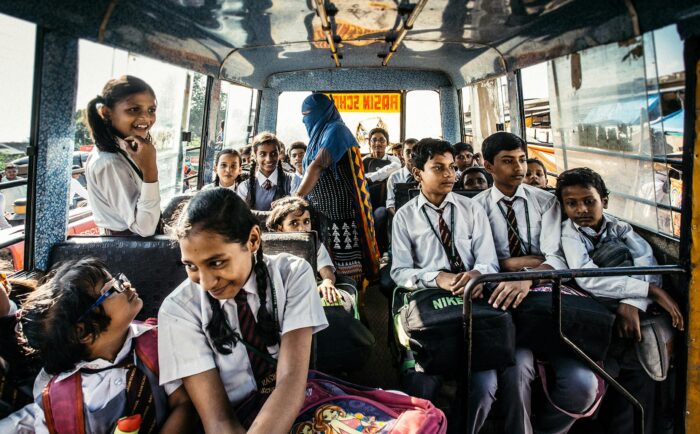
Learning in an Unfamiliar Tongue? Reflections from a Delhi School

Shweta Singh is a IVth year student of a teacher education programme, at Department of Education, Gargi College
Dr. Jyoti Raina
Dr. Raina is a professor at the Department of Education, Gargi College, University of Delhi, and is the second author of this article.
In this article, Shweta Singh and Jyoti Raina reflect upon India’s centralised structures of school education, linguistic diversity, language hierarchy, and recent policy-proposals in this regard.
As the contours of our republic were being drawn during the constituent assembly debates; language emerged as an emotive, political and identity question. The language-related debates reflected the aspiration of every community to be able to preserve and receive an education in their own language. Jaipal Singh Munda, an adivasi, liked to assert his linguistic identity in the august assembly by speaking in his own tribal language Mundari.
All our languages merit recognition in the spirit of an inclusive India. In December 2025 when President Murmu released the Indian constitution in Santhali language (which was not even a scheduled language till as late as 2003) ; the event was celebrated as a moment of inclusion. However there continues a language hierarchy embedded in school education and higher education systems. The Santhals are the third-largest tribe in our country with a population of 7 million yet one can hardly find more than one or two Santhali medium schools in the states where Santhali-speaking people reside. In recent years educational policy has placed an increasing spotlight on the language question.
Policy proposals
Released after a 34-year gap, the National Education Policy (NEP) 2020 is the third education policy of independent India, introduced in an era of nation-building that is significantly different from the contexts of National Policies of Education of 1968 and 1986.
NEP 2020 presents policy-proposals for a comprehensive transformation of India’s education system by emphasizing holistic, multidisciplinary learning, flexibility, lifelong learning and 21st-century skills suited to the educational needs of contemporary times.
For school education, it prioritises foundational literacy and numeracy, encourages experiential learning, and focuses on teacher development, technology integration, and inclusive education to ensure accessible, high-quality learning for all students.
A significant commonality across all three National Policies of Education in India (1968, 1986, and 2020) is the continued recommendation of the three-language formula in schools, which encourages students to learn three languages: their mother tongue or regional language, Hindi or another Indian language, and English or any other language. Another key continuity in educational policymaking is the recognition of the value of mother tongue in learning, aiming to promote instruction in it at least during the primary grades. This policy-emphasis reflects the pedagogical and cultural strength inherent in learning through the mother tongue in early years of a child’s education while additionally acquiring proficiency in other languages after a while.
The NEP 2020 lays a renewed thrust on the centrality of language in school education linking up the language question to proposals concerning the medium of instruction. This emphasis is also a response to the increasing global attention upon the role of language as a tool of cultural continuity, social inclusion and cognitive growth. Languages are not merely medium of instruction in school education but shape the knower’s perception, construction of reality and response to the immediate environments; acting as a bridge between thinking, learning, identity and society shaping ‘our sense of who we are and our relationship to the world’ (Kanno, 2003, pp. 3). Educators have unequivocally argued that learning best occurs when the medium of instruction is children’s own mother tongue, as that is what children think with and learn in, rendering it a powerful classroom learning tool.
Wherever possible, the medium of instruction until at least Grade 5, but preferably till Grade 8 and beyond, will be the home language/mother tongue/local language/regional language (NEP 2020, pp. 13).
NEP 2020
Building upon the NEP 2020, the National Curriculum Framework (NCF) 2023 brought out by the National Council of Education Research and Training, New Delhi, further reinforces the importance of using the home language in early and preparatory years as follows:
Children learn best in the language they understand well; this language should be the primary medium of instruction in the foundational and preparatory stages
NCF 2023, pp. 39
The Multilingual Tapestry of India
India, now regarded as the world’s most populous country, possesses a rich and diverse linguistic demographic profile. We are home to 1,369 languages, of which 22 are constitutionally scheduled and are spoken by 96.7% of the population. Another 99 non-scheduled languages are spoken by 3.2% of Indians, while the remaining 1,248 languages fall into the ‘other’ categories. Thirty languages have more than one million speakers, and Hindi is the first language of 43.6% of the population (GoI, 2011). Various national-level documentations have also highlighted that India has among the world’s highest Linguistic Diversity Indices at 0.914, which assesses the probability that two randomly selected Indians speak different mother tongues. Evidently the possibility that people speak myriad languages is high, as the index indicates. This rich diversity means that nearly every village and city speaks a language of their own!
Mother-tongue based Multilingual Education (MTB-MLE)
The concept of MTB-MLE has been invoked in global and Indian discourse on the presumption that students need to learn all the skills of a language they well-understand before being introduced to additional languages as part of the school curriculum or as a medium of instruction. It is an education that begins in the young students’ first language, which serves as the medium of instruction; and later introduces additional language(s) in an additive approach.
MTB-MLE thus relieves students from the mental load of linguistic decoding while building a strong foundation of literacy, numeracy and environmental concepts. The approach introduces or rather layers additional languages through gradual support from ‘scaffolded pedagogies that respect learners cognitive loads and linguistic trajectories’ (UNESCO, 2025, pp. 58).
The MTB-MLE draws upon practices like code-switching (alternating languages across sentences) and code-mixing (using words or phrases of different languages in a sentence) which language puritans traditionally do not do in formal settings. Public examination question papers, for example, often bear the instruction- you may write the answers in Hindi or English but use one language throughout your answer script. MTB-MLE also involves translanguaging in which there is no tight separation of different languages in classroom processes but rather a focus on meaning-making using varied language resources; and transknowledging which integrates meaning across languages using multiple linguistic resources (Cummins, 2023). NEP 2020’s suggestions on a planned use of several languages reflect somewhat similar assumptions. The policy-text states:
Children will be exposed to different languages early on, starting with the mother tongue/home language and moving gradually to other languages (GoI, pp. 14).
Challenges for School Education
What does the diverse multilingual tapestry of our country portend for school education? To examine this question we need to look at the origins of the modern Indian education system during the colonial times.
The British introduced a Western-style centralised system with standardisation replacing the more localised, decentralized model that prevailed in different communities in various parts of the country. English had replaced Persian as the official language of government and court proceedings. A language hierarchy was created in which though elementary schooling took place in the major regional language of the community in which a school was located (which sometimes happened to be the mother tongue of majority of the students) but English also became valued as the language of opportunity in professional spheres such as law and civil service.
The consequence of such a hierarchy was that students aspired for English proficiency as they reached higher grades since it was vested with possibility for entry into the professions as well as the British government’s administration apparatus. The minority languages tended to be excluded from the formal education system either as medium of instruction or as school subjects; while dominance of English as a language with power got established, a hierarchy that has firmed up since colonial times.
Psychologists refer to a subtractive approach in which a more dominant language replaces another language (possibly people’s first language), in a process fraught with loss of language, identity erosion and poorer learning outcomes (Mohanty, 2022). Explaining this Raina (2022) writes:
When more than one language was used, the languages appeared hierarchically and consequently home language disappears quite swiftly in favour of regional language; and national language in favour of other international languages. The number of options related to language studies decreases as children go into higher levels. Such an approach is not conducive to the preservation of indigenous and endangered languages ( pp. 82).
The most significant consequence of the inherited language inequality is that the medium of instruction when children come to school is often different from the language that they are familiar with. Moreover, language(s) are also a school curriculum subject which is assessed through a testing regime.
How can children be expected to learn to read and write a language that is neither their home language nor do they speak or hear it in any other context? National surveys have documented that 44% of children in India who come to school speak a language different from the medium of instruction that is followed in the classroom (NCERT, 2022). This makes it important to undertake empirical research as well as field- based micro-surveys that map children’s language in specific classroom contexts. Yet teachers seldom begin teaching with such a linguistic mapping of students in their classroom vis-à-vis the language of instruction so as to be responsive to language inequalities in the classroom.
A Delhi context
Within the Delhi context, system-level assessments such as the PARAKH (Performance Assessment, Review and Analysis of Knowledge for Holistic Development) 2024 that aim at evaluating students’ competencies shape how foundational learning is understood and measured in government schools. The Directorate of Education (DoE), Government of NCT of Delhi, recently conducted its own learning-survey, with a focus on language and mathematics at the primary stage. The survey categorises students into graded proficiency levels such as beginner, emerging, and proficient; based on their performance in structured assessment tasks.
The findings indicated that while a proportion of students demonstrate age-appropriate competencies, a significant number continue to struggle with basic reading, comprehension, and numeracy skills (Government of NCT of Delhi, 2023); a grim reminder that ‘schooling ain’t learning’ (Pritchett, 2013).
To explore the language question the authors undertook a language mapping in the specific context of their own teaching in the Delhi-based DoE affiliated school. The school has also been selected to host the pilot program for the new Montessori Laboratories, a DoE initiative; aimed at introducing hands-on, holistic learning for early childhood care and education gradually across all its schools in Delhi.
English is the official medium of instruction in the school. However, classroom observations indicated that teachers prefer using both English and Hindi, depending on the classroom context and pedagogical needs. English is primarily used while referring to textbooks, in written work in students’ notebooks for class and home work, and formal instruction; while Hindi is often used to explain concepts across subjects, give instructions, and facilitate classroom interaction.
This description forms the contextual background for the classroom language mapping data presented as follows.
| S No | Student | Language at Home | Mother Tongue | Preferred Student Language |
|---|---|---|---|---|
| 1. | M01 | Bundelkhandi/ Hindi | Bundelkhandi | Hindi |
| 2. | M02 | Avadhi/Hindi | Avadhi | Hindi |
| 3. | M03 | Hindi/ Haryanvi | Haryanvi | Hindi |
| 4. | F01 | Hindi /Rajasthani | Rajasthani | Hindi |
| 5. | F02 | Bundeli /Hindi | Bundeli | Hindi |
| 6. | M04 | Hindi /Haryanvi | Haryanvi | Hindi |
| 7. | M05 | Bundelkhandi /Hindi | Bundelkhandi | Hindi |
| 8. | F03 | Haryanvi /Punjabi /Hindi | Punjabi | Hindi |
| 9. | M06 | Bengali/ Hindi | Bengali | Hindi |
| 10. | M07 | Hindi/Gujarati | Gujarati | Hindi |
| 11. | M08 | Bihari /Hindi | Bihari | Hindi |
| 12. | M09 | Bihari/Hindi | Bihari | Hindi |
| 13. | M10 | Urdu/Hindi | Urdu | Hindi |
| 14. | F04 | Urdu/Hindi | Urdu | Hindi |
| 15. | M11 | Haryanvi/Hindi | Haryanvi | Hindi |
| 16. | M12 | Hindi /Rajasthani | Rajasthani | Hindi |
| 17. | M13 | Hindi /Rajasthani | Rajasthani | Hindi |
| 18. | M14 | Hindi /Rajasthani | Rajasthani | Hindi |
| 19. | M15 | Hindi /Avadhi | Avadhi | Hindi |
| 20. | F05 | Bihari/Hindi | Bihari | Hindi |
| 21. | F06 | Hindi /Maithili | Maithili | Hindi |
As the table reflects, the students enrolled in this class are multilingual, speaking more than a dozen different languages in a cosmopolitan city like New Delhi. Yet ironically even though all the students were Hindi speakers; their assessment in Hindi language, as studied in the school as a subject under the auspices of GoI’s NIPUN (National Initiative for Proficiency in Reading with Understanding and Numeracy) Bharat programme which aims at achievement of foundational literacy and numeracy towards the end of academic session 2026-27 among all grade III students, did not reveal proficiency in reading or writing it.
A learning-outcome-evaluative orientation is evident in the readiness module (level 1) used under the NIPUN Bharat programme for Classes II and III follows a not-very-variegated, mostly uniform, colour-coded format across the subjects of Hindi, English, and Mathematics. It has a relatively standardised structure, with similar task formats and visual layouts for Hindi, English, and Mathematics. Of course such uniformity is intended to enable comparability of learning outcomes and systematic tracking of foundational competencies across classrooms but there is a need for creating more possibilities to draw upon multilingualism that is available in classrooms such as above.
The language mapping coupled with interactions with students of this grade indicates that they use their mother tongue at home, prefer to converse in it in school with friends as well but had not necessarily learnt to read or write in it as a school subject; which explains to some extent the relatively poor NIPUN Bharat assessment scores. A recent argument ‘When instruction and assessment are predominantly in a non-native medium many children confront the double burden of decoding an unfamiliar language and grasping new concepts’ (UNESCO, 2025, pp 55) is salient in this regard.
The mother tongue of all the students in grade IV of the school is Hindi but that’s not the medium of instruction in the school. The imperative of beginning a child’s education in their own language as expressed in the slogans like ‘Education through the language of the learner’s home is a foundation for equity and quality learning’(UNESCO, 2021) and ‘When children begin their education in a language they understand, classrooms transform from spaces of struggle into environments of discovery and empowerment’ (Tim Curtis, Director, UNESCO Regional Office for South Asia cited in Bhasha Matters, 2025) remains elusive. Recent studies have shown that early education conducted in unfamiliar languages undermines both equity and effective learning outcomes (Jhingran, 2021).
Another noteworthy research from rural Kenya’s (Africa is a post-colonial society like ours with colonial education system inheritances) public primary school system with data gathered from grades I, III and VIII presents a similar finding. The mother tongue of all the students is an indigenous language called Nandi. Interviews and observations indicated that students do not use this language at school but mainly at home and while interacting with friends informally. The languages at school are Swahili and English with the exception of separately designated mother- tongue teaching in grades I-III which is of course in Nandi language. The findings of the research indicated that students had no hesitation in not using the Nandi language at school for formal studies. While students took pride in their vernacular heritage, they appreciate the usage of English and Swahili at school as a medium of instruction since they believed in their importance in a multilingual world (Kanno, 2003).
Way forward
The learning outcomes- policy-emphasis on foundational literacy and numeracy under initiatives such as NIPUN Bharat represents an important commitment at the national level prompted by such concerns of poor learning. However, pedagogical tensions in its classroom implementation are as evident from some of the classroom nuggets shared above reflect. The categorising of students in assessment systems as beginner, emerging, or progressive and proficient; seeks standardisation but risks imposing linear and not-very-natural stages on language development. School practices do not include classroom level language mapping, such as one undertaken by the authors which aim to examine what language is meaningful as medium of instruction and which languages could be specified as school subjects. Even if the medium is aligned to mother tongue/other languages, where does the teacher find adequate bilingual, trilingual or multilingual learning resources, and support programmes to develop such resources?
Yet teachers in this school were sensitive to ineffectiveness of monolingual teaching in a multilingual classroom reality. Therefore, although English is the designated medium of instruction, teachers frequently employ both English and Hindi in response to classroom contexts and students’ needs. These flexible language practices reflect an implicit recognition of MTB-MLE within classrooms, often extending beyond formal curriculum prescriptions. Advancing a meaningful MTB-MLE for social and epistemic justice requires more than theory or policy articulation. It necessitates simple steps of responsiveness on part of teachers’ that begin with legitimising children’s first languages within early grades. This involves simple practices for example translanguaging and transknowledging which were prevalent in this school in the classroom we observed. The NEP 2020 and NCF 2023 offer some preliminary hints in this direction which may be just the panacea for fostering effective learning in schools.
References
- Cummins, J. (2023). Critical multilingual language awareness: The role of teachers as language activists and knowledge generators. Language Awareness, 32(4), 560-573.
- Kanno , Y. (2003). Negotiating bilingual and bicultural identities, Mahwah, NJ: Lawrence Erlbaum.
- GoI. (2011).Census of India. New Delhi: Office of the Registrar General and Census Commissioner, India.
- Mohanty, A. K. (2022). Multilingualism as a resource: Implications for education, In R.C.Tripathi, B.R.Kar & N. Pande (Eds) Towards an Integrative Psychological Science: Issues, Approaches and Applications. (pp. 163-189). Singapore: Springer Singapore.
- Pritchett, L. (2013). The rebirth of education: Schooling ain’t learning. CGD Books.
- Raina, J. (2022). Inequality in education: Towards a consensualisation of status quo [Review of the book Education and Inequality: Historical and Contemporary Trajectories, edited by V. Gupta, R. K. Agnihotri, & M. Panda]. Social Scientist,50(3-4), 82.
- GoI. (2020). National Education Policy 2020.
- National Council of Educational Research and Training (2022). Foundation Learning Study. New Delhi: NCERT.
- National Council of Educational Research and Training (NCERT). (2023). National Curriculum Framework for School Education. New Delhi: NCERT.
- Ministry of Education, GoI. (2021). National Initiative for Proficiency in Reading with Understanding and Numeracy (NIPUN Bharat): Mission Document (pp. 16–21, 32–35). New Delhi: Government of India.
- UNESCO. (2025). Bhasha Matters: Language, Learning and Equity in Education. Paris: UNESCO.
- Jhingran, D. (2021). Language, learning and equity: The role of multilingual education. In C. Benson & K. Kosonen (Eds.), Language issues in comparative education. Leiden, The Netherlands: Brill.
- Government of NCT of Delhi. (2023). Prakhar survey on learning: Report on student learning outcomes (pp. 2–6). Directorate of Education, Delhi.




 Login
Login
This article really resonated with me as a trainee teacher and offers a thoughtful and sensitive reflection on how language shapes a child’s experience of school. It shows how language affects learning, confidence, and identity, and why using child’s own languages in classrooms can make learning more fair and meaningful.
Fantastic article, beautifully explained challenges of multilingual schooling. It shows keen observation n hardwork. lack of culturally relevant learning materials, parental concerns about dominant language proficiency, and the difficulty of balancing local cultures with national language are big challnges to multilingual education.Its inclusive,evocative n outstanding 👍
I like how this article tells how students struggle and feel excluded when schools teach in languages unfamiliar to them, showing the need for more inclusive, multilingual classrooms on ground.
This article beautifully highlights a critical yet often overlooked dimension of education — the role of language as both a means of learning and a marker of identity in our classrooms. By linking national policy (like NEP 2020) with real classroom observations, the authors remind us that children don’t just learn subjects — they learn through languages they understand and live in. The classroom language mapping in the Delhi school was particularly insightful, showing how even students labelled as “Hindi speakers” navigate a rich multilingual reality that schools frequently ignore. This piece is a timely and important contribution to educational discourse because it pushes us to move beyond idealized policy texts and towards classroom practices that are inclusive, equitable, and responsive to children’s linguistic worlds. More educators and policymakers should read this and reflect on how language hierarchies shape student confidence, participation, and true learning.
This article beautifully shows that language in classrooms is not just a medium of instruction but a matter of identity, equity, and learning itself. The classroom language mapping is especially powerful in revealing how children labelled as “Hindi speakers” actually navigate rich multilingual worlds that schools often overlook. From translanguaging and MTB-MLE, it asks us to move beyond policy ideals to real classroom possibilities. A thoughtful and timely reminder that equitable education begins by listening to the languages children already live in.
As a B.El.Ed student, I found this article very useful and meaningful. It shows how children in one class speak many different languages at home, but in school they are taught mostly in one language. This makes learning hard for many students. The idea of learning first in the mother tongue is very important because children understand and think better in the language they use at home. I also liked how the article explains that teachers already mix languages in class to help students. This made me think about my own school visits. This article teaches us that respecting children’s home language can make learning easier and fairer for everyone.
This article clearly shows how difficult it can be for children to learn in a language they are not comfortable with. It made me understand that language is not just about words, but also about feelings, confidence, and identity. The real classroom experiences shared here are very touching and meaningful. This piece reminds us that education should be kind, inclusive, and respectful of every child’s background.”
This is a very well-written and thoughtful article. It clearly explains the importance of language in children’s learning and connects education policy with real classroom experiences. The examples from the Delhi school make the discussion more realistic and relatable. I especially liked how the article highlights teachers’ flexible use of languages to support students. Overall, it is an insightful piece that strongly reminds us why recognising children’s home languages is essential for meaningful and inclusive education.
This is a deeply insightful and much-needed reflection on language, equity, and classroom realities. The work beautifully bridges policy, theory, and lived school experience, making the discussion both academically strong and socially relevant. The focus on multilingual classrooms and language hierarchies brings much-needed attention to an often overlooked dimension of schooling. Truly inspiring to read such rigorous scholarship that keeps children’s voices and everyday classroom realities at the centre. A meaningful and impactful contribution to contemporary educational discourse.
This article serves as a strong reminder that language is central to identity. And Shweta and jyoti ma’am illustrate well that while the NEP 2020 policy recognizes the value of the mother tongue, the language hierarchy in schools creates a major barrier to real fairness. The language mapping of the Delhi classroom is especially shows that even when students are labeled as Hindi speakers,their understanding is influenced by a rich, diverse mix of dialects and regional languages. By supporting translanguaging and MTB-MLE, the authors provide a thoughtful way forward. They suggest transforming classrooms into places of discovery instead of struggle.
A truly insightful article that challenges us to listen to the unfamiliar tongues in our classrooms.