How much of ‘Science’ is really science?

Science is expected to undertake an effort which would understand the world objectively. After all, earth’s gravity is not subjective to one’s assumptions. It is taken for granted as if it is real, and exists as part of our daily experience beyond question.
However, how legitimate are the claims that Science is not a knowledge-discovering enterprise but a knowledge-creating enterprise, and that Science doesn’t find truths but makes them? After all, these ‘truths’, these ‘theories or laws about reality’, are not things that are constructed out of thin air. If they should be dependent upon anything at all, then that could only be our perception, our observation of outside world, or, in more technical terms, ‘facts’.
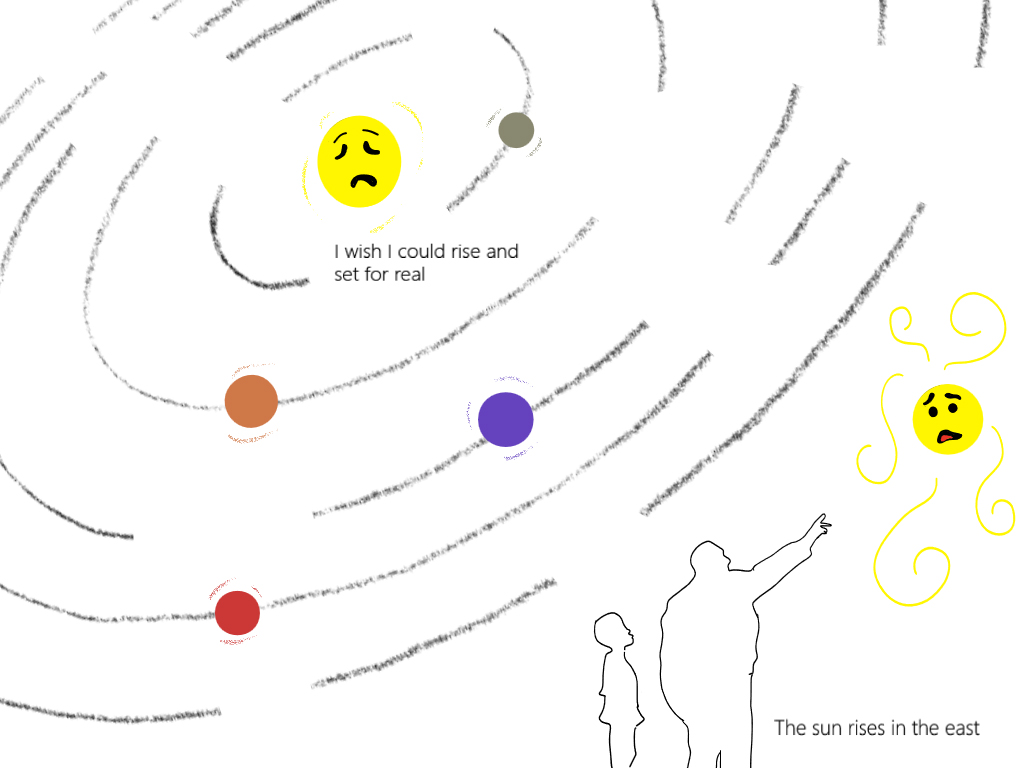
But what is a ‘fact’? What can be meaningfully said about a ‘fact’ is this: A ‘fact’ is a set of words in a language that aims at portraying a phenomenon that is happening or happened in the outside world. Examples: 1. The Sun rises in the east. 2. The Earth revolves around the Sun. Therefore, the Sun does not rise in the east.
Look at these two ‘facts’. Apart from the fact that they are contradicting each other, are we really sure that these ‘facts’ are unalloyed, objective portrayals of the phenomenon that we observe every day? Since most of us are used to the heliocentric perspective, we will say that example 2 is the ‘right fact’, and that example 1 is just used for our ‘everyday convenience’ and that it doesn’t portray what is actually happening out there.
Even though it may not be a ‘fact’ anymore, example 1 ‘was’ a ‘fact’ and people believed that it was an ‘objective fact’ in the past. Surely they must have believed it for a reason. People in the past were not irrational fools. Therefore, the reason could only be this: They thought they had ‘sound justification’ in ‘interpreting’ what they saw, which is the appearance of the Sun in a particular region every morning and its slow movement and then finally its disappearance in a particular region every evening, as the revolution of the Sun around the Earth. And they had every right to believe it. We too observe the same phenomenon everyday. Compare this with example 2. Isn’t example 1 more close to the common sensical aspect of observation than example 2? Isn’t it ‘more raw’ than example 2? But still we don’t say that example 1 is the ‘right fact’.
In order to say example 2 is the ‘right fact’ and to believe it, we would have to believe in other ‘theories and observations’ that enable us to ‘interpret’ our observation of the motion of the Sun as what is claimed in example 2; we would have to believe in ‘theories and obervations’ that enable us to ‘jump’ from geocentrism to heliocentrism. Some of these that enabled the ‘jump’ historically are the problem of retrograde motion of Mars, inconsistency in calendar dating, Kepler’s and Newton’s laws, etc. It is the collection of all these that enabled us to ‘interpret’ the phenomenon as example 2, the ‘right fact’.
We will find that example 1 is also not as much ‘innocent’ if we scrutinize it. The assumptions and theories implicit in example 1 (some of which are also implicit in example 2) are ‘our physiological theory of human vision is reliable’, that is our naked eye does not cheat us; ‘we are not dreaming or being manipulated by the Devil’, ‘our earth is stationary’, etc. We should also notice that there is always a possibility that some ‘example 3’, along with its own theories, assumptions and observations, will come up in the future and will ‘revolutionize’ or ‘rearrange’ our perspective and interpretation of the same phenomenon and hence will be considered the ‘right fact’.
Now, in view of all this, can we still say that ‘facts’ are unalloyed, unbiased, objective portrayals of ‘what is out there’? There doesn’t seem to be a simple answer to this question.
At any rate, the positivistic view that there are objective facts out there has been called into question here. Now shall we give up on objectivity and settle for relativism? How much of Science is subjective to assumptions that we make? Or, shall we instead try to come up with a new notion of objectivity that is informed by all these historical arguments?
What place does Science deserve in our epistemology?
Kaamesh Singam is pursuing PhD in Philosophy at IIT Kanpur
Featured Photo by Mathew Schwartz on Unsplash





 Login
Login
Readers' Reviews (2 replies)