
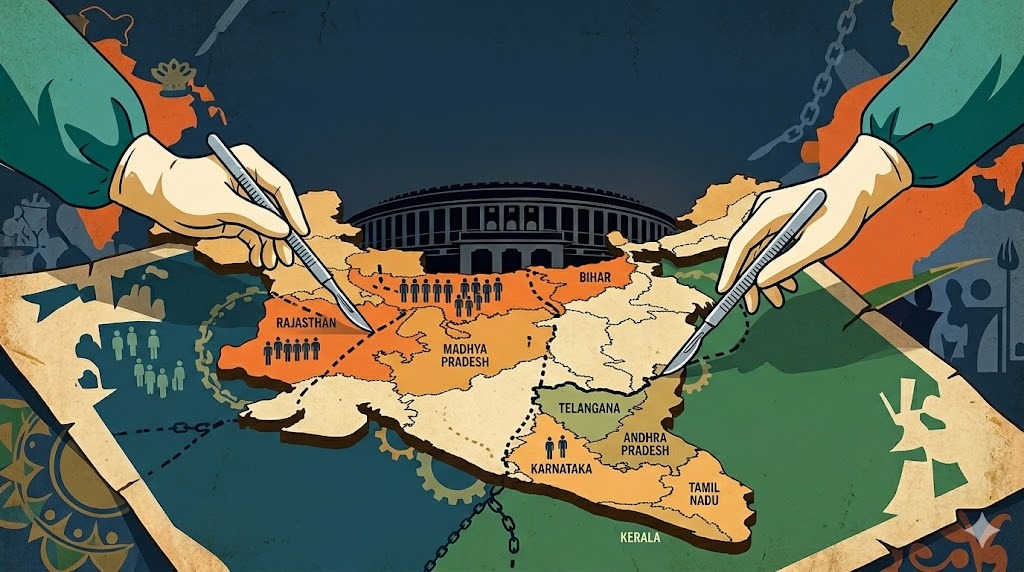
Delimitation: The great Indian political surgery

Amritha is a public policy professional. She loves working at the intersection of data and policy.
Amidst the state elections, on 16th April 2026, three important bills were tabled in the parliament–The Constitution (One Hundred and Thirty-first Amendment) Bill, 2026, The Delimitation Bill, 2026, and The Union Territories Laws (Amendment) Bill, 2026. The Constitution (One Hundred and Thirty-First Amendment) Bill, 2026, proposes significant changes to the size and composition of State Legislative Assemblies by restarting the process of delimitation and removing the long-standing constitutional freeze, in effect since 1976, on readjustment of seats based on population. Despite the assurance of 50% seat increase to Southern States from the Home Minister Mr. Amit Shah[i], the bill failed to procure two-third votes required for passing of a constitutional amendment bill. Through this policy explainer, we dive into India’s contentious issue of demographic divide between Northern Vs. Southern states and democratic shift through delayed census and population surges to ask: Whether a formula for seats can also be a formula for equitable representation?
The Great Freeze of Boundaries
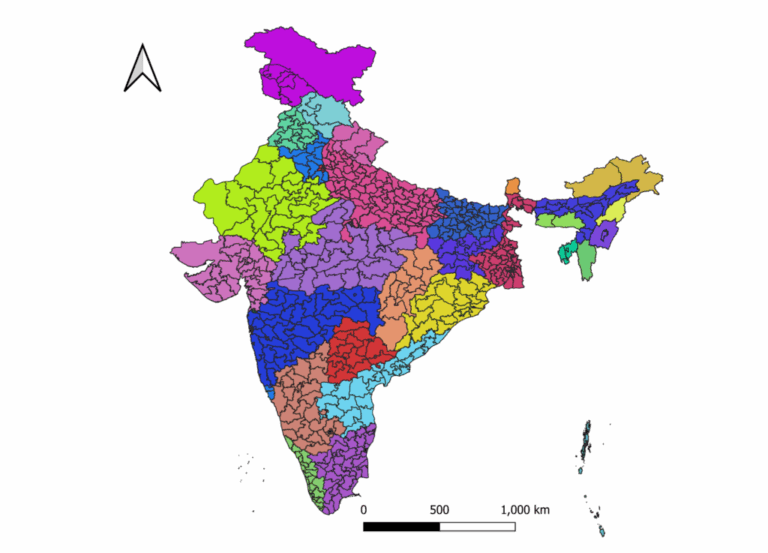
Delimitation in India, empowered by Articles 81 and 82 of the Indian Constitution, is the act of fixing or demarcating boundaries of electoral constituencies to ensure equitable representation of people. This exercise is carried out by the Delimitation Commission, which has judicial immunity and no scope for judicial redress. Such commissions have been constituted 4 times–1952, 1963, 1973, and 2002.[ii] In all four exercises, the commission did not disclose the methods that were followed in the delimitation of electoral constituencies.[iii]
For nearly five decades, since 1972, the parliament (Lok Sabha) seats have been frozen in time (fixed at 543) to control the exponential population growth. The last delimitation exercise, a partial one, was carried out in 2002 (extended till 2008) with 2001 census data to redraw the political boundaries for the fixed seats to ensure fair representation.[iv]
In 2003, the 84th amendment was pushed to pause delimitation till the first census taken after 2026 to incentivise states to effectively control population growth without the fear of losing political leverage. Ideally, the next delimitation exercise is expected to be initiated after the release of the 2027 census data.
The North-South paradox
Delimitation is essential for rebalancing power in the Lok Sabha. It ensures equitable representation for women, SC, and ST communities while shifting the distribution of seats from the south to the north to match demographic changes. When the country’s first state reorganisation commission recommended dividing the states, it failed to consider the north-south differences in the size of its population. As per 1971 census data, the states of Tamil Nadu, Karnataka, Kerala, Andhra Pradesh, and Telangana had a population of 13.58 crores together, and in the selected northern states of Uttar Pradesh, Bihar, Madhya Pradesh and Rajasthan, the population was 18.17 crores together. Between 1971 and 2011, the southern and selected northern states have almost doubled.
| State/UT | 1971 Population (in 000s) | 1971 National Share | 2011 Population (in 000s) | 2011 National Share |
| Southern States’ Total Population and Share | 135,820 | 24.78% | 252,477 | 20.86% |
| Selected northern states population, total and share | 181,758 | 33.16% | 444,604 | 36.74% |
According to the population projection report 2011-36[v], in 2026, the states with a higher population share, like Uttar Pradesh (17.1%), Bihar (9.3%), together hold 26.3% of Lok Sabha seats[vi], whereas the five southern states together have a population share of less than 20%. Moreover, as per SRS 2023[vii], the Total fertility rate (TFR) of the southern states with a TFR average of 1.4 has dipped way below the Replacement Fertility Level (RFL) of 2.1, highlighting a serious concern. Consequently, an average Member of Parliament from Uttar Pradesh represents 30 lakh people, and in Tamil Nadu, it is 18 lakhs.[viii]
Another consequence for a state with less population comes through the devolution of taxes. A state with a larger population receives higher per capita transfers compared to a smaller state, irrespective of its GSDP. [ix] India has a significant vertical as well as horizontal fiscal imbalance since most broad-based taxes are assigned to the Union government. Article 270 provides the scope for devolution of the taxes to the Finance Commission. The commission is responsible for formalising the measures to address the fiscal needs and capacity of each state government to channel the funds from affluent regions to the poorer ones. Based on the commission’s recommendations, the share of taxes is to be distributed to the states. Based on the recommendations of the 15th Finance Commission, the weightage for income distance and population is 60%, outweighing the weightage for Demographic Performance, which is 12.5%, incentivising the densely populated non-affluent states. Under the 15th Finance Commission, the combined share of southern states is 15.8%, still less than the share of taxes devolved to Uttar Pradesh at 17.93%.[x]
Considering the huge share of votes and population in the northern states, the delimitation exercise is feared by the southern states that it might further dilute the decision-making power and their representation in the parliament. The leaders of the southern states also view it as a penalty for taking up measures to effectively control the population growth to date. Despite political differences, to address this issue, Tamil Nadu CM M.K. Stalin and Andhra Pradesh CM Nara Chandrababu Naidu have been actively advocating for increasing the population growth.[xi]
Global examples
Germany (Mixed Member Proportional Electoral System)
Follows a two-vote system–one for local candidates and another for the party. The delimitation process does not have any ramifications here because of the compensatory seats given to parties with strong parties in malapportioned states, carrying more direct seats than have been allocated for that state.[xii]
USA (Equal Proportions Method)
Each state will be allotted one seat from the total seats of the House of Representatives, and the rest will be allotted based on the population of each state.[xiii]
EU (Degressive Proportionality)
Larger member states elect more members of the European Parliament (MEPs) than smaller ones, but smaller member states have more MEPs per population than larger ones[xiv] (retaining the existing structure).
UK (Boundary Commissions)
To avoid gerrymandering, constituency boundaries are reviewed periodically by the four independent Boundary Commissions to make sure that constituencies all have a similar number of voters.[xv]
Beyond numerical lens
Splitting larger states
K.M. Pannikar, a diplomat from Kerala, critiqued Uttar Pradesh’s domination and the consequences of regional imbalance in the State Reorganisation Commission Report of 1955. Panikkar cited an example of how the United Germany was protected from the domination of Prussia by reducing its representation in Parliament. Likewise, densely populated big states like Uttar Pradesh should be given an option of keeping the existing seats with a higher population ratio represented per MP or a choice to split the state. This will safeguard the federal principle of equality of units.
More quota to migrant recipient states
States that attract more inter-state migrants due to the abundance of jobs because of the drop in population growth, should be given a larger share of seats. This can drastically reduce the imbalance between states based on unequal populations.
More incentives in Tax Revenue Distribution
To compensate for the hampered representation, states that are bound to lose seats through delimitation exercises should be given a higher share of tax revenue collected by the Union government.
The bottom line
Delimitation is a constitutional obligation and is a need of the hour. However, it should be done fairly, without overrepresenting or underrepresenting any state by upholding the federal principle and national unity.
References
- Jahnavi (April 16, 226). Amit Shah announces new share of southern states in Lok Sabha amid concerns. The News Minute. https://www.thenewsminute.com/news/amit-shah-announces-new-share-of-southern-states-in-lok-sabha-amid-concerns
- Election Commission of India (n.d).
- Verma, A. K. (2006). Delimitation in India: Methodological Issues. Economic and Political Weekly, 41(9), 794–799. http://www.jstor.org/stable/4417903
- Verma, A. K. (2008). Fourth Delimitation of Constituencies: An Appraisal. Economic and Political Weekly, 43(11), 12–16. http://www.jstor.org/stopulation of the able/40277247
- National Commission on Population. (2020). Population projections for India and states, 2011-2036 Report
- Election Commission of India. (n.d.). Delimitation of constituencies.
- Office of the Registrar General & Census Commissioner. (2023). Sample Registration System (SRS) statistical report 2023.
- India’s Emerging Crisis of Representation | Carnegie Endowment for International Peace
- Rao M. G. & Singh, N. (2001). The political economy of center-state fiscal transfers in India (Working Paper No. 107). Stanford University.
- Ministry of Finance. (2024). Annex – 4B: Statement showing state-wise distribution of net proceeds of union taxes and duties. https://www.indiabudget.gov.in/doc/rec/annex4b.pdf
- India Today. (2024). Why Chandrababu Naidu and M.K. Stalin want bigger families in the South. https://www.indiatoday.in/india-today-insight/story/why-chandrababu-naidu-and-mk-stalin-want-bigger-families-in-the-south-2621264-2024-10-22
- The ACE Electoral Knowledge Network. (n.d.). Germany: Delimiting districts in a Mixed Member Proportional (MMP) electoral system. https://aceproject.org/ace-en/topics/bd/annex/bdy/bdy_de/mobile_browsing/onePag#:~:text=At%20the%20beginning%20of%20each,proportion%20as%20far%20as%20possible
- U.S. Census Bureau. (n.d.). About Congressional Apportionment. https://www.census.gov/topics/public-sector/congressional-apportionment/about.html#:~:text=%22Apportionment%22%20is%20the%20process%20of,which%20each%20state%20is%20entitled
- European Parliament. (2024). A permanent system for seat allocation in the EP. https://www.europarl.europa.eu/cmsdata/280848/PolDepC%20_A%20Permanent%20System%20for%20Seat%20Allocation%20in%20the%20EP_Muller.pdf
- UK Parliament. (n.d.). Parliamentary constituencies. https://www.parliament.uk/about/how/elections-and-voting/constituencies/#:~:text=18-,How%20are%20constituency%20boundaries%20decided?,the%202024%20UK%20general%20election


 Login
Login