

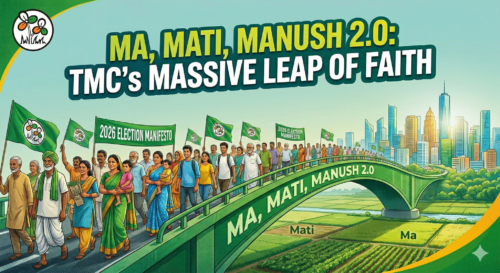
TMC’s Maa, Mati, Manush 2.0: From ‘Safeguarding’ to ‘Strategic state-building’

Ujjwal is an electoral researcher with PhD from Jawaharlal Nehru University, Delhi
The mid-day heat shimmered over the streets of Khagra, a vibrant, tight-knit locality in Berhampore. A young TMC worker, his shirt slightly damp at the collar, approached a cluster of homes distributing the Didir 10 Protigya (Didi’s 10 Promise) pamphlet. This paper was more than a flyer; it signaled the party’s pivot from 2021’s ‘Emergency Relief’ to a 2026 blueprint for ‘strategic state-building’. With every doorstep visit, he subtly redefined the iconic “Ma, Mati, Manush” slogan, casting voters as active stakeholders in Bengal’s quest for economic upliftment.
In 2021, the TMC campaigned like a ‘lifeguard’, focusing on saving people against the dual tempests of COVID-19 pandemic and Cyclone Amphan. It was the era of ‘Emergency Relief’ and the governance was largely centred on crisis management and providing a safety net, prioritising the survival of its citizens. However, as the 2026 election approaches, a notable transition is in motion. The nucleus has shifted from tactical populism to strategic state-building, laying emphasis on long-term industrial governance. The promises are focused on expanding the scope and financial base of already enforced schemes. The iconic slogan “Ma, Mati, Manush” is no longer symbolic of just welfare and protection. It has broadened its horizons to encompass economic permanence and long-term stability.
West Bengal’s MSME landscape presents a stark structural paradox: while the state leads the nation in women’s entrepreneurship and ranks second in total unit volume, this numerical strength has failed to catalyze significant macroeconomic growth or global competitiveness. Hence, the TMC has directed its efforts towards developing the Global Trade Centre, expanding deep-sea and river port networks, and creating modern logistics hubs to boost exports. It wants to use its geographic advantage to serve a two-fold purpose- generating high-quality employment and establishing Bengal as “India’s Gateway of Trade for Eastern India”. There is a determination to rebrand Bengal from a ‘social welfare state’ to a ‘maritime trade and powerhouse’ by enshrining logistics as Bengal’s new economic lifeline. It also seeks administrative expansion by establishing seven new districts and a geographical reorganisation to bring governance closer to citizens.
Claiming deliberate fiscal obstruction, the manifesto states that the Centre has withheld Bengal’s rightful funds of nearly ₹2 lakh crore across various central schemes, denying regular wages, housing, road connectivity, and something as basic as drinking water. Hence, the emphasis is on “making Bengal truly self-reliant” to insulate the local welfare from the central government. There is an ambition to focus more on state-funded models to escape the Centre’s fiscal bottleneck. Initiatives like a dedicated Agriculture Budget of ₹30,000 crore to strengthen farming and allied sectors, indicate a deeper penetration into the rural economy. It is a step ahead from the Krishak Bandhu scheme that provided an annual support of ₹10,000 per acre to 68 lakh small and marginal farmers. The Banglar Bari scheme, funded exclusively by the state, aims to provide housing for 3 million additional families alongside the existing 10 million units. By operating independently, the initiative is positioned as a permanent alternative to the PMAY partnership, effectively bypassing ongoing inter-governmental frictions. These schemes reflect a broader vision of autonomy and self-sufficiency, steering towards total administrative decoupling.
By promising to settle long-overdue dearness allowance arrears and adopt the 7th Pay Commission, the manifesto directly addresses years of growing tension with the state’s workforce. This shift is more than just a fiscal update; it is a calculated effort to mend fences with urban professionals and the “Bhadralok” community. In doing so, the party hopes to bridge the gap between its traditional rural supporters and a middle class that has long felt ignored.
Building on the success of Duare Sarkar, the 2026 manifesto pledges annual Duare Chikitsa camps to provide doorstep premium healthcare services, along with Fair Price Medicine Shops to provide affordable medicines and reduce expenditure for citizens.
The ₹500 hike (across all categories) in the financial assistance under the flagship Lakshmir Bhandar scheme puts forth the women of West Bengal as the party’s strongest electoral pillar. The party has also assured to provide ₹1,500 per month to every educated, unemployed youth in the state between the ages of 21 and 40, for a period of five years, under the Banglar Yuba-Sathi scheme.
The manifesto of Trinamool Congress accuses the Centre of attempting to “disenfranchise the people of Bengal”, highlighting the SIR exercise as an attempt to erase ordinary voters from the rolls, leading to heightened anxieties and widespread distress. Reiterating the vision of “Bengal First”, the manifesto lays emphasis on being “Swanirbhar” or self-reliant so as to escape the constraints of the Centre.
However, the sheer scale of the state’s self-reliance agenda is creating an enormous fiscal challenge. Funding popular programs like Banglar Bari and the upgraded Lakshmir Bhandar entirely from its own coffers, all while trying to cover the massive gap left by nearly ₹2 lakh crore in withheld central funds, is putting tremendous pressure on the treasury and risks pushing the state toward unsustainable levels of debt. Beyond money, the massive ‘strategic state-building’ initiatives, new ports, logistics hubs, and the seven newly planned districts require top-tier administrative talent and highly efficient land acquisition processes. To truly tackle these implementation hurdles, the government needs a sustainable long-term fix: it must aggressively ensure that the new industrial base, those ports and trade centres actually translates into local tax and non-tax revenue, making the whole operation financially viable.
Ultimately, the TMC’s 2026 blueprint transcends conventional electioneering; it is a fundamental redefinition of the state’s relationship with both its citizens and the Centre. The party has transitioned its political identity from a ‘lifeguard’ to a ‘strategic state-builder.’ This demanding new role involves leveraging initiatives such as Banglar Bari and a significant infrastructure investment to cultivate a distinct and self-reliant economic structure. The evolution from the ‘Didir 10 Ongikar’ of 2021 to the ‘Banglar Jonno Didir 10 Protigya’ of 2026 marks a significant transition from the aggressive “Khela Hobe” slogan to a more grounded “Survival Roadmap”. This strategic pivot aims to redefine West Bengal as a self-reliant economic entity, moving beyond its previous identity as a mere political alternative. By focusing on long-term sustainability, the rhetoric now emphasizes the state’s resilience and its capacity to thrive as an independent economic powerhouse.

 Login
Login