

Sino-Taiwan tensions and India’s strategic dilemma

Nuresh is a researcher with a strong interest in geopolitics and political affairs, currently studying at Ramjas College, University of Delhi.
Foreign Policy is the art of establishing priorities
Henry Kissinger
As Sino-Taiwan tensions escalate, India faces a strategic dilemma in balancing economic vulnerability, maritime security and diplomatic autonomy.
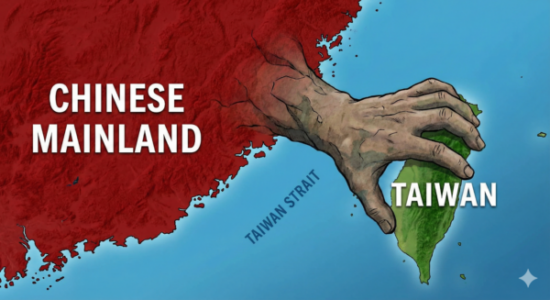
Rising tensions across the Taiwan Strait have emerged as one of the most consequential fault lines in today’s geopolitics. Recent military exercises conducted by Beijing in the Taiwan strait have fueled the rising tensions and have increased the possibility of a large-scale invasion and takeover of Taiwan. What was once viewed as a regional dispute between Beijing and Taipei has increasingly become a global concern with major implications for technology supply chains, international trade and security dynamics of South East and North East Asia. For India, Taiwan may be geographically distant yet strategically exposed.
While India has traditionally approached the Taiwan question with utmost caution, the evolving strategic environment in the Indo-Pacific and South China sea makes the disengagement increasingly untenable. The Taiwan issue today is not merely about land claims or sovereignty claims but has also evolved about critical technologies, maritime trade and regional influence, these factors directly intersect with India’s long term strategic interests.
The Sino-Taiwan Flashpoint
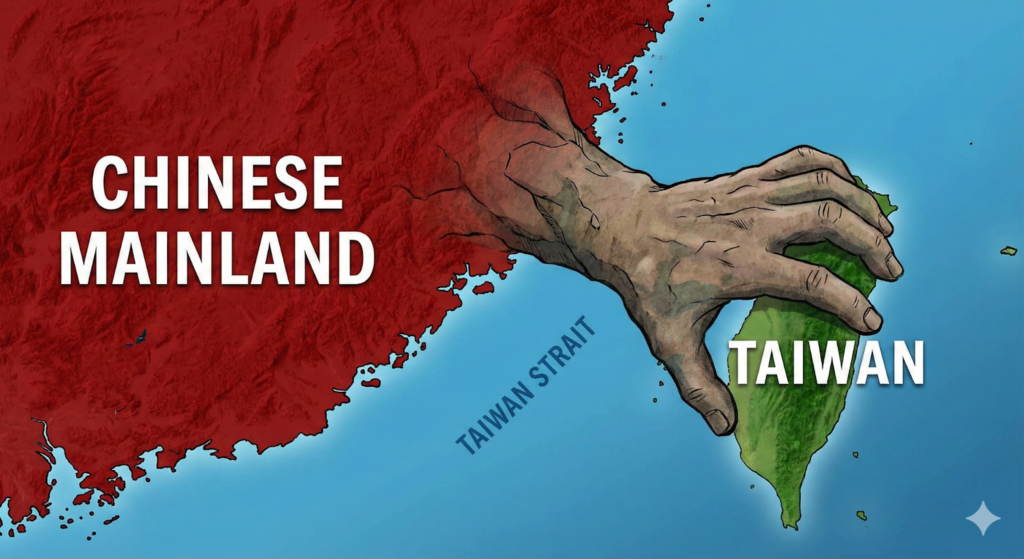
The Sino-Taiwan dispute can be traced back to the Chinese Civil War (1945-1949) after the Japanese surrender at the end of the Second World War, the conflict culminated in the victory of The Chinese Communist Party under Mao Zedong and establishment of the People’s Republic of China on the mainland China. The defeated nationalistic party retreated to the island of Taiwan, where they maintained they were the legitimate and the only government of all of China thus laying the foundation of the unresolved cross-strait divide.
The One China Policy can be traced back to the Cairo declaration (1943) and has remained the cornerstone of Beijing’s approach towards the Taiwan issue, asserting that Taiwan has been an inalienable part of China citing historical context. India formally acknowledged this position in 1950 and was among the first ones to recognize the People’s Republic of China and has maintained diplomatic relations since then, while avoiding official recognition of Taiwan.
It is also important to distinguish between the One China principle which is asserted by the People’s Republic of China and the One China policy followed by the United States. Beijing’s principle claims Taiwan as a sovereign part of China but Washington merely acknowledges China’s position while also maintaining unofficial relations with ROC Taiwan under the domestic legislation which is Taiwan Relations Act (1979).
Recent escalation
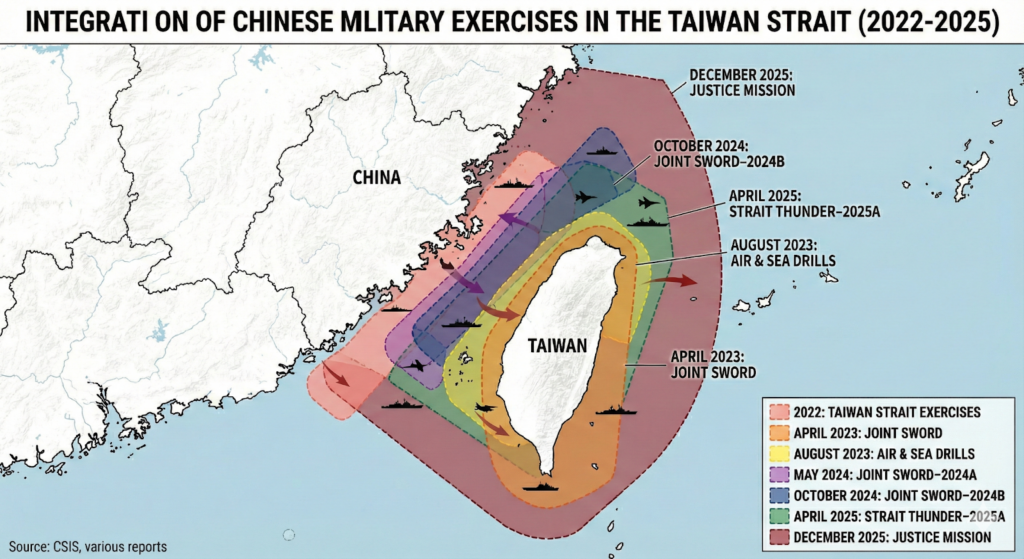
In the last decade, the People’s Republic of China has rapidly ramped up its military budget which is estimated from $210.6 billion in 2016 to $317.6 billion in 2024 and military capabilities. China has conducted more complex and intrusive operations and military exercises in the Taiwan strait (2022), (April 2023 Joint Sword), (August 2023), (May 2024 Joint Sword–2024A), (October 2024 Joint Sword–2024B), (April 2025 Strait Thunder–2025A) and most recently December 2025 Justice Mission. While Taiwan’s most recent presidents have hailed from a party that does not view the island as a part of unified China, a departure from the view of the previous Kuomintang government.
Taiwan on the other hand has also expanded its military budget which is estimated to be $16.47 billion in 2024. The United States has also been deepening its ties with Taiwan, including by selling more than $18 billion in arms and unveiling a budget of $250 million for its de facto embassy in Taipei. The United States has also sent several senior administration officials to Taipei. These developments are seen by China as an active act of aggression and a clear violation of its One China Policy thus leading to rising tensions in the region.
Why Taiwan Matters
Taiwan occupies a central position in contemporary geopolitics due to its dominance in advanced semiconductor manufacturing, producing over 90 percent of leading-edge semiconductors that power the world’s manufacturing and electronics economy and generating over $165 billion in revenue, representing approximately 20.7% of the country’s GDP. Taiwan today is also a flourishing democracy. It is a free and vibrant society and for the United States and the West, the island is a bastion of democratic values and of freedom against the Communist China’s assertive presence in the region. Any escalation in the cross-strait region would have immediate global implications.
For India, these stakes translate into a complex strategic dilemma.
Implication on India’s Economic & Technological Sector
India’s exposure to the Taiwan question is perhaps most evident in the domain of semiconductors. As India is still very much dependent on the import of semiconductor from Taiwan and the East Asian supply chain. In 2022-23, 14.64 billion chips were imported at a valuation of Rs 1.97 lakh crore. In 2021-22, India imported 1.071 lakh crore worth of chipsets according to economic times.
In 2023, the country exported a total of $2 billion in semiconductor devices, primarily to the United States ($1.89B), Germany ($10.8M), and to Thailand($10.5M). During the same year the country imported $6.71 billion worth of semiconductor devices.
Despite recent policy initiatives from the government to promote domestic chip manufacturing, India is still heavily reliant on imports from Taiwan and East Asia. These imports are essential to India’s growing manufacturing ecosystem, which includes consumer electronics, industrial machinery, and automobiles.
Disruptions in supply resulting from the escalating Beijing-Taipei tensions could have immediate consequences for India’s manufacturing ecosystem which could potentially hamper production lines and increase product costs. The implications could extend further into the defence sector, where advanced semiconductors are used to manage surveillance systems, missile guidance and radar platforms.
India’s digital economy, which is growing, spanning from telecommunications and fintech, is projected to generate income worth $200 billion by 2030, use of artificial intelligence is equally dependent on stable semiconductor availability. As India tries to position itself as a global digital power hub, disruption in semiconductor supply could undermine both economic and technological growth.
Implications for India
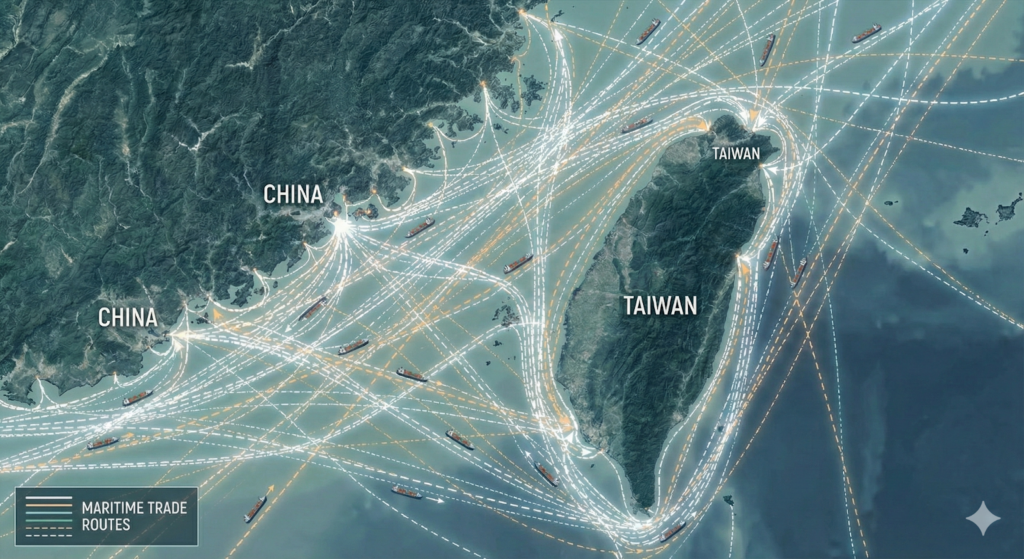
The strategic relevance of the Taiwan strait cannot be viewed in isolation as approximately $2.45 trillion worth of goods, which is over one-fifth of global maritime trade transited from the Taiwan strait in 2022 and for India it constituted for approximately $170 billion dollars. Taiwan strait also forms part of a broader maritime spectrum linking the South China Sea to the Indian Ocean through critical sea lines. Any political or military escalation in Taiwan strait could inevitably increase military activity across the passage which could affect commercial shipping trade routes and regional stability.
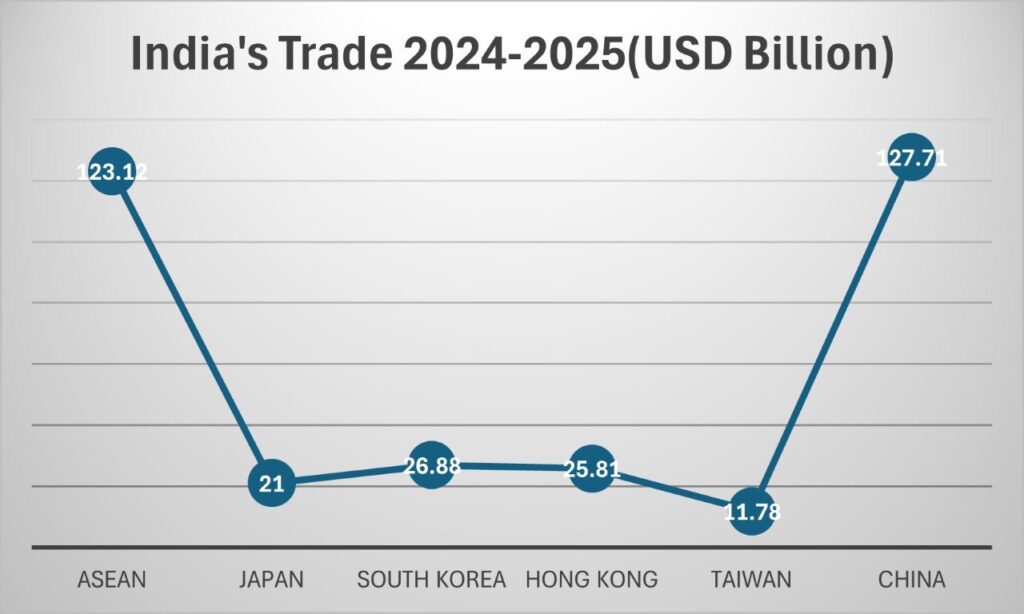
On the other hand, Malacca strait is one of the world’s most important maritime choke points which lies in the heart of the global maritime network. A large and significant portion of India’s trade and energy imports and exports transits through this narrow passage. In 2024-2025, India conducted trade worth of $123.12 billion with ASEAN, for Japan it constituted $21 billion, Korea ($26.88 billion), Hong Kong ($25.81 billion), Taiwan($11.78 billion) and China ($127.71 billion dollar).
Increasing Chinese naval deployments linked to Taiwan contingencies could intensify surveillance and power projections in the Eastern Indian Ocean. Sino-Taiwan escalating tensions, therefore are deepening India’s existing security challenges.
Strategic Autonomy v/s Alignment
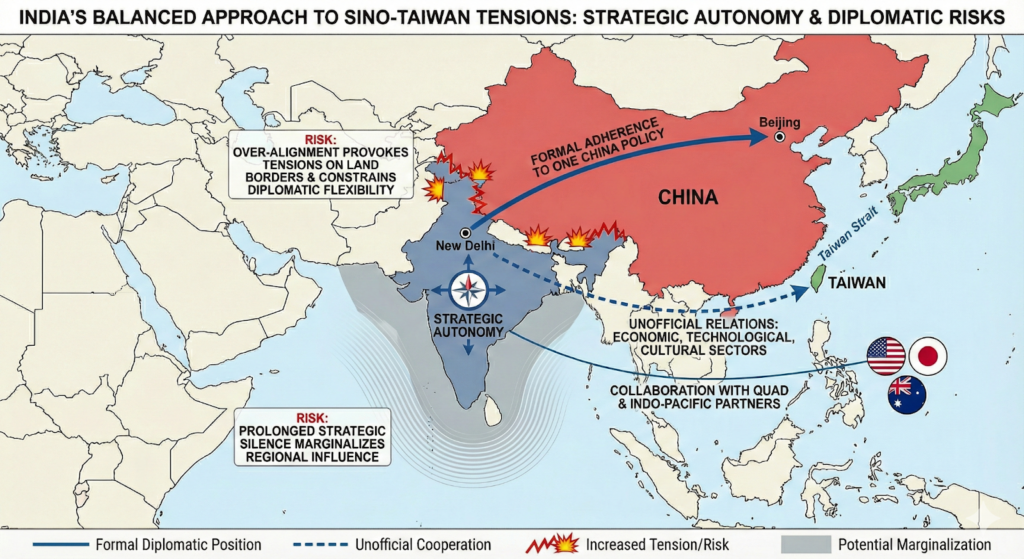
India’s approach to rising Sino-Taiwan tensions is shaped by its long standing commitment to strategic autonomy, which is reflected in its cautious and balanced diplomacy. New Delhi has continued to formally accept and adhere to One China Policy, while maintaining unofficial relations in economic, technological and cultural sectors with Taipei and also collaborating with its partner in OUAD and Indo-Pacific reflecting a balanced approach.
Yet this cautious approach carries risk. Over alignment with any one bloc could provoke already tense tensions along India’s contested land borders with China and constraint diplomatic flexibility. Conversely, prolonged strategic silence risks marginalizing its influence in regional norms.
As the Sino-Taiwan tensions escalate, India must balance its strategic autonomy with promising preparedness by strengthening supply chain resilience, maritime security and calibrated diplomacy in the Indo-Pacific.
References
- Embassy of India, Beijing. (n.d.). India-China trade relations. Retrieved January 2, 2026, from https://eoibeijing.gov.in/eoibejing_pages/MjQ
- Center for Strategic and International Studies (CSIS). (2021). Disruptions to trade in the Taiwan Strait would severely impact China’s economy. Retrieved January 2, 2026, from https://www.csis.org/analysis/disruptions-trade-taiwan-strait-would-severely-impact-chinas-economy
- Trading Economics. (n.d.). Taiwan military expenditure. Retrieved January 2, 2026, from https://tradingeconomics.com/taiwan/military-expenditure
- Center for Strategic and International Studies (CSIS). (2023). China’s military in 10 charts. Retrieved January 2, 2026, from https://www.csis.org/analysis/chinas-military-10-charts
- OEC World. (n.d.). India: Semiconductor devices exports and imports. Retrieved January 2, 2026, from https://oec.world/en/profile/bilateral-product/semiconductor-devices/reporter/ind
- Trade.gov. (n.d.). Taiwan semiconductors, including chip design and AI. Retrieved January 2, 2026, from https://www.trade.gov/country-commercial-guides/taiwan-semiconductors-including-chip-design-ai#:~:text=Taiwan%20remains%20a%20critical%20hub,20.7%25%20of%20the%20country’s%20GDP
- Bush, R. C., & O’Hanlon, M. (2017). One China policy primer. Brookings Institution. Retrieved January 2, 2026, from https://www.brookings.edu/wp-content/uploads/2017/03/one-china-policy-primer-web-final.pdf
- The Economic Times. (2024, October 10). India’s semiconductor chip import increased 18.5% to ₹1.71 lakh crore in FY24. Retrieved January 2, 2026, from https://economictimes.indiatimes.com/tech/technology/semiconductor-chip-import-increased-18-5-to-rs-1-71-lakh-crore-in-fy24/articleshow/116047484.cms?from=mdr
- Ernst & Young (EY). (n.d.). The role of fintech in building Viksit Bharat. Retrieved January 2, 2026, from https://www.ey.com/content/dam/ey-unified-site/ey-com/en-in/insights/financial-services/documents/ey-the-role-of-fintech-in-building-viksit-bharat.pdf
- Ministry of Commerce & Industry, Government of India. (n.d.). Trade analytics – country-wise trade data. Retrieved January 2, 2026, from https://trade-analytics.commerce.gov.in/public/country
- Consulate General of India, Hong Kong. (n.d.). India–Hong Kong relations. Retrieved January 2, 2026, from https://cgihk.gov.in/page/india-hong-kong-relation/
- Embassy of India, Tokyo. (n.d.). India–Japan bilateral relations. Retrieved January 2, 2026, from https://www.indembassy-tokyo.gov.in/eoityo_pages/NjA
- Ministry of External Affairs, Government of India. (2025, July). India–ASEAN relations. Retrieved January 2, 2026, fromhttps://www.mea.gov.in/Portal/ForeignRelation/India-ASEAN-july-2025.pdf



 Login
Login
Very insightful and interesting piece of research put up!
A timely, well-researched article offering nuanced analysis of Sino-Taiwan tensions and India’s economic, technological, and strategic dilemmas today, globally relevant.
The Situation is complex with Trump’s unpredictable foreign and trade policy forcing India to take friendly stand towards China.
I’m so impressed with your work; congratulations!”