

Rebellious women: Whose JNU after all?

Saurabh Suman is a master’s student in Transcultural Studies at Heidelberg University, Germany. His research interests include culture, gender, and politics. During his leisure time, he enjoys cooking, music, and poetry.
Women of Jawaharlal Nehru University know that they are not Devis but humans. Goddesses, unlike humans, must always be respected, not because they are respectable, but because they are imagined as divine beings – pure, forgiving, and self‑sacrificing. Deification is a simultaneous process of othering and distancing. Men make women Devis so that they neither have to share equality with them, nor be judged for the uneven distribution of labour, as they(men) are “mere humans,” that secures their comfort and advantage. Women who step down from the altar and refuse this sanctified pedestal claim their desire, autonomy, and imperfection. JNU has always been a home for such women.
Although it has never really stopped, we are now witnessing a fresh escalation of attacks on students, especially women students in JNU, through some of the harshest means yet: “For the first time in Jawaharlal Nehru University’s history, all four office-bearers of the students’ union have been rusticated for two semesters.”
JNU, in contrast to most educational institutions, or any institution in India for that matter, has historically had a higher proportion of women students, before the recent decline that saw a sharp drop “from a majority of 51.1% in 2016–17 to less than half the student body at 43.1% in 2024–25.” JNU is a unique institution which, through affirmative action, awards additional points to women, along with deprivation points to students from remote and structurally disadvantaged regions. This process ensures that women, not only from privileged but also from underprivileged sections of society, who are subjected to multiple layers of discrimination, can continue their studies and not lose them to the lack of opportunity. Regardless of the continued, systematic attacks on the university, and despite the specific burdens that come with being women students of JNU, they have continued to prove themselves – making the university shine, sustaining its culture, and holding the idea of JNU intact in their heart and aloft.
Women Activists on campus and their struggles
There are several instances that reveal how fearless the women of JNU are, and how the current government, along with the present V-C who herself is a woman, is bent on curbing their voices. Those who were, and tragically but unsurprisingly are, always assumed to be silent and conforming, look power in the eye, ask questions, and fight for their rights; the restlessness to silence them is telling.
From 5 January 2020, when a mob of goons stormed the university hostels, vandalising the campus and brutally beating innocent students, to the assault on then JNUSU President Aishe Ghosh, who was left with “16 stitches on her head and bruises on her waist,” the message was loud and clear: a woman who dares to lead and resist must be punished. In 2023, the rustication and declaration of out of bounds for Swati Singh, a woman activist, for two semesters in the final year of her PhD, only reinforced and highlighted this message. As briefly mentioned above, now, the rustication of Aditi Mishra, the current student union president, along with the other three office-bearers – K Gopika Babu, Danish Ali, and Sunil Yadav – as well as former JNUSU president Nitish Kumar, continues this trajectory. Three out of the five rusticated are women. The disproportionate presence of women among those punished is not a coincidence, nor an isolated incident; it reflects a consistent and targeted pattern of administrative action against women activists who fight for students’ rights, and especially women students’ rights, on campus and beyond.
Whose Space Is It?
Many women students on campus admit that they had to convince, negotiate with, and sometimes fight their parents in order to come to JNU, especially after the image of the university, and particularly its women, was systematically maligned in the public sphere. Through orchestrated media trials on television news channels, targeted campaigns by right-wing outfits, and the circulation of misinformation, the women of JNU were turned into a national anxiety. As a result, several of my female friends in JNU have shared experiences of discriminatory treatment and moral policing once people around them got to know that they are JNU students – whether from strangers, authorities, or even their own relatives. These are not mere examples of the personal cost that women of JNU pay for being associated with an institution that allows them the space to be human – to laugh, love, and dream. They also mirror the deeply rooted patriarchy of our society, for which women’s liberation, and especially women who speak, disobey, and dissent against power, is the greatest threat.
Most disheartening is to witness that JNU, a place in the heart of one of the most unsafe places like Delhi, long considered a sanctuary of freedom for women, is, tragically, shrinking as a safe space for them. Ring Road – the road encircling the administrative and school buildings – and other public spaces such asdhabas are becoming alarmingly and increasingly unsafe for women students. DJ nights, Holi celebrations, and other public gatherings are growing less inclusive, with misogynistic, casteist, and communal songs blaring as men flex their bodies and privilege. Growing cases of sexual harassment and stalking now make women hesitate before stepping out of their hostels during “odd hours.” The inefficient and power‑compliant Internal Complaints Committee (ICC), a nominated body that replaced the elected Gender Sensitisation Committee against Sexual Harassment (GSCASH), has numerous alleged instances of victim‑blaming and protecting perpetrators. The space of JNU is turning anti-women.
JNU Fights Back
As the women of JNU should rightfully claim the lion’s share of the university’s reputation and success over the years – they who once formed the majority of its student body and still contribute substantially – they now face a twofold adversity: from the internal administration and from the external forces of society, government, and its machinery, all directed towards JNU. They face this because, first, they are women; second, because they are women of JNU. The attacks on JNU and its women students and leaders are not mere hatred, but a systematic attempt to silence them, a message to the women of JNU that they must descend from the pedestal of dissent and start conforming, and to others that if they dare to reflect this fearlessness, they will be punished accordingly.
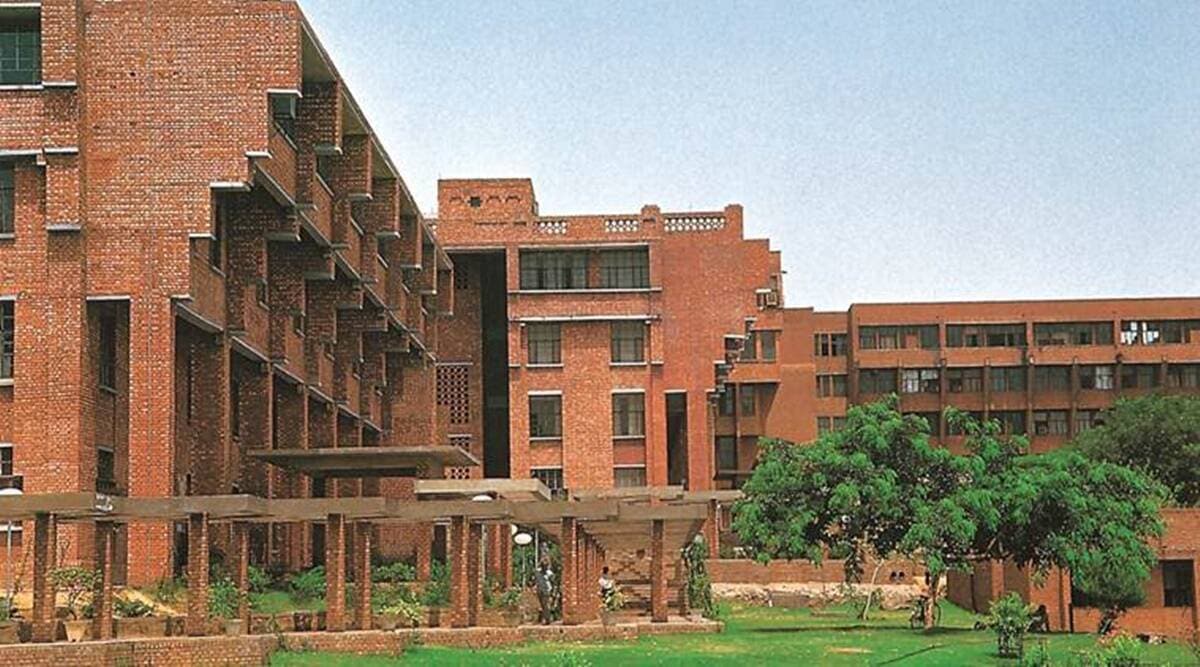
JNU cannot stand without the freedom of all kinds that it holds at its very heart. When I say JNU, I mean even the administration and others who day and night strive to kill the very idea of JNU that these women have built and sustained through years of continuous study, struggle, and speaking out. The women of JNU have made it the university we are proud of, and they know well how to fight for it. For the legacy of these rebellious women is carved deep into the red walls of JNU that have always inspired and will continue to inspire generations of students who come here to study, as well as those who never set foot on campus but carry JNU in their hearts. This legacy endures, while vice-chancellors and governments come and go.
Featured Image Credits: Indian Express





 Login
Login
“Apna Khata Portal” is a reliable and user-friendly online service that helps people access their land-related information with ease. Through “Apna Khata Portal”, users can check important records like Khasra, Khatauni, and Jamabandi from anywhere without visiting government offices, saving both time and effort. “Apna Khata Portal” enhances transparency in land record management and simplifies the entire process for citizens. Overall, “Apna Khata Portal” is a valuable digital initiative that empowers users by providing quick and convenient access to their property details.
Read More: https://apna-khata.com/
Technology-driven platforms are helping citizens access public services more efficiently, and समग्र आईडी पोर्टल is a strong example of this progress. It offers a centralized system where individuals and families can store their information and connect with various government schemes. This structured approach reduces paperwork and makes verification faster and more reliable. Many users appreciate the ability to update their details, check eligibility, and manage records without visiting multiple offices. The platform also supports transparency by maintaining accurate and organized data. As digital adoption increases, improving performance and mobile accessibility can further enhance user satisfaction. With its practical features and growing importance, समग्र आईडी पोर्टल continues to simplify administrative processes and improve service delivery. Overall, it helps create a smoother and more efficient experience, allowing citizens to access essential benefits and services in a convenient and organized manner.
Visit: https://samagraidd.com/