
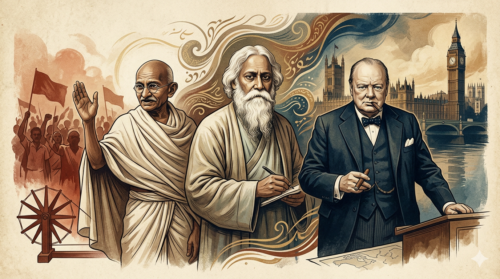
Power, Poetry, and Protest: Churchill, Tagore, and Gandhi in the Early Twentieth Century

Dr. Jayan Philip is a Contributing Writer at The ArmChair Journal. He is a distinguished History educator with over three decades of teaching experience in India and abroad. He is the author of ‘The Indomitable Gandhi, The Indefatigable Mandela’, ‘Quintessentially Quizzical’, and the forthcoming ‘The Cute, the Naughty, the Fluffy, and the Most Faithful’. A noted quizmaster and prolific writer, he has conducted nearly 204 quiz shows and has 37 publications to his credit. Through his scholarship, writing, and engagement with young minds, he continues to foster historical understanding, critical inquiry, and a lasting love for learning.
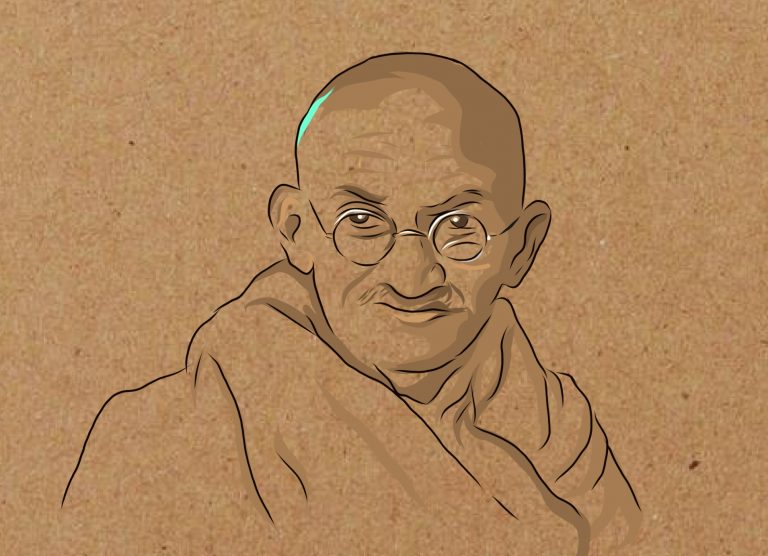
The contradictory statements and common perceptions of the Gandhian ideology or philosophy in relation to the lives of Tagore and Churchill, an admirer and a critic of the Mahatma, call for closer introspection.
The three legendary figures have left a legacy that is difficult to erase from the minds of intellectuals, academics, researchers, and the common person. Mahatma, Tagore, and Churchill – Their lives were no less ordinary but were stories of grit, determination, and strong convictions. All three are distinctively different in terms of genre and fields of study. The lives of Mohandas Karamchand Gandhi and Winston Churchill were like railway tracks that remained parallel in their thought processes and the trajectories they chose and followed. The former was known as the’ Mahatma’ and the latter the ‘Bull Dog’, offering a different perception and a contradictory perspective to the reader and the school-going child at the same time. Gandhi’s strong stance against racism, opposition to colonial rule, and suppression of his native land did find or form a massive support base cutting across all social stratifications or divisions.
The Gandhian era was different from the other eras of the Indian freedom struggle, whether it was the constitutional phase under the Early Nationalists, the Assertive phase led by Bal Gangadhar Tilak, or the violent streams of thought and actions followed by Bhagat Singh, Chandrasekhar Azad, Udham Singh or Subhash Chandra Bose.
Churchill, on the other hand, believed in the might of the British Empire and went by the diction that might is right, no matter what the consequence would be for the state or the people under an elected governance or foreign domination. It was aggressive nationalism on Churchill’s part, not a moderate or progressive welfare-state model. This raises many questions about the authenticity of political leadership, which may be inconsistent with the ethical code of conduct acceptable on the common thread or strand of the fundamental right to equality.
As one delves into the three lives of Churchill, Tagore, and Gandhi, there are more commonalities than divergences between Rabindranath and the Mahatma. All three were nationalistic and stood for their respective countries, but each one’s patriotic zeal took a different turn, leading to outcomes that perhaps changed the destinies of millions in today’s developing and developed economies. Though the poet did not venture into the political domains of power and authority, his thoughts and writings, in most cases, aligned with the Gandhian concept of Swaraj.
The political freedom they espoused (Gandhi and Tagore) was inextricably linked to the emancipation of people with low incomes, the creation of economic equality amongst the citizens, and the reduction of the rich-poor divide. The doctrine of Ahimsa, or moral force in daily life, also found resonance with both. A word free of bigotry, hatred, and selfishness was not just their imagination; it was a realistic goal they wanted to achieve. Gandhi’s version of political power is perhaps noteworthy and the ideal for the world today. He wrote in January 1939.
Political power cannot be our ultimate aim. It is one of the means men use for their all-round development. The power to control national life through national representatives is called political power. Representatives will become unnecessary if the national life becomes so perfect as to be self-controlled. It will then be a state of enlightened anarchy, in which each person becomes their own ruler. He will conduct himself in such a way that his behaviour will not hamper the well-being of neighbours. In an ideal State, there will be no political institution and therefore no political power. (CWMG Vol. 74, p 380 )
Though Tagore differed with Gandhi on the methods adopted during the Non-Cooperation Movement, his admiration and deep reverence for the Mahatma were well known and evidenced by the deep bonds they had developed over the years since 1915, after Gandhi’s return from South Africa.
Gandhi financially supported Visva Bharati in November 1937 with a cheque for 13,010 (Gandhi 2018,164). In the same year, Tagore wrote to Gandhi about his intent to make him a Life Trustee of Visva Bharati. “In these last frail years of my life, it will be great consolation to know that the institution to which I have given the best part and energy of my life will have you as one of its guardians” (Mukherjee 2021, 152)
Gandhi declined the offer of becoming a life trustee of Visva Bharati but came to Shantiniketan in February 1940, which also happened to be the last meeting between the Nobel laureate and the father of the nation. (Mukherjee 2021, 155)
In 1937, Rabindranath was seriously ill and sank into a coma, but later in his recovery, he penned these lines to the Mahatma. “The first thing which welcomed me into this world of life was your message of affectionate anxiety, and it was fully worth the cost of sufferings which were unremitting in their long persistence” (Bhattacharya 1997:167).
While Gandhi’s 21 years in South Africa saw him as a lawyer and a leading advocate of freedom, Bengal was nurturing and building a tall literary edifice and a future Nobel laureate, Rabindranath Tagore. The five ashrams that Gandhi established (Phoenix, Tolstoy, Kochrab, Sabarmati, and Wardha) initiated and integrated the concept of community living in practice. The experiments carried out in each of them were very similar in reasoning and impact. It was simplistic in thought, minimalistic in action, and optimistic in conception. Life in the Ashrams revolved around Gandhi and with Gandhi. As the waters of the Sabarmati silently flowed a few meters away, the Gandhian ethos slowly but steadily gained momentum at a pace perhaps unimaginable in Gujarat.
The Civil Disobedience Movement took shape, and the Dandi March commenced in the Sabarmati Ashram, which was slowly rocking the boat of the mighty British. Its repercussions were felt across India and even attracted world attention. It was the fragile hands of Gandhi picking a lump of salt on April 6, 1930, in Dandi, that the world took note of and which shook the might of the British.
Tagore showed keen interest in developing the villages around Shantiniketan. He built a community that later became a university, acting as a beacon of learning and reflective thinking. By the beginning of the 20th century, Gandhi and Tagore had established themselves as towering personalities in their domains. Also, they evoked admiration from the learned and the privileged to the downtrodden. In 1900, the brightest jewel in the British crown was India, but it was made one of the poorest nations in the world by the brutal, selfish, war-mongering monarchy called Great Britain.
The India of the 1900s was not just a picture of contrasts, but extreme poverty, diabolical policies, and total ignorance of the colonial masters who drained every resource from India. Gandhi felt the pulse of the nation and the need of the hour, which was the emancipation of people on low incomes, as his words show.
I will give you a talisman. Whenever you are in doubt, or when the self becomes too much with you, apply the following test. Recall the face of the poorest and the weakest man whom you have seen, and ask yourself, if the step you contemplate will be of any use to them. Will she gain anything? In other words, will it lead to swaraj (freedom) for the hungry and spiritually starving millions? Then you will find your doubts and your self melt away. (CWMG, Vol 96,p 311)
It is very clear from his poems that Tagore was deeply moved by the extreme poverty in rural areas and keen to address or eradicate it. The few lines from one of his poems, “Give me the strength never to disown the poor or bend my knees before the insolent might”, highlight this fact. (Mukherjee, 2021, p.2-5)
In one of the essays titled Bharatvarshiya Samaj, he tried to distinguish between the concepts of Hindu Samaj and the nation-states that together made up European Civilisation. Rudrangshu Mukherjee, in his book Tagore and Gandhi- Walking Alone, Walking Together, has maintained that two conclusions can be drawn here: the desire or primary objective of the Hindu Samaj was social welfare, and this was not the responsibility of the respective governments of the day but a collective responsibility of each individual, which constitutes the community and the society at large. (Mukherjee, 2021, p. 3-6).
Tagore was more inclined towards the Upanishads, while Gandhi’s three major literary influences on his life were Unto the Last by John Ruskin, Leo Tolstoy’s ‘The Kingdom of God is Within You’ and Henry Thoreau’s ‘Civil Disobedience’.
Both were confined to two different worlds but blended well professionally and personally – Tagore was a poet, an essayist, an educator, a lyricist, and a short story writer. Gandhi, on the other hand, was also a writer and was very convincing in his speeches, writings, and negotiations. He stood by what he said and believed in, no matter what the consequences were.
Tagore’s engagement with political events can be traced back to the early stages of the Indian freedom movement, particularly in response to the tumultuous and controversial decision made by Lord Curzon in 1905 to partition Bengal. This division not only disrupted the cultural and social fabric of the region but also ignited widespread protests and resistance among the populace. The decision was later reversed in 1911 by Lord Hardinge, reflecting the growing unrest and unity among the people. In this context, Tagore composed the poignant song ‘Ekla Chola Re’ (If no one answers your call, walk alone), encapsulating the spirit of individual perseverance and self-reliance in the face of adversity. Through his art, he conveyed the deep emotions tied to these political upheavals, urging his fellow countrymen to remain steadfast in their quest for freedom and dignity.
Gandhi was moved by the lyrics and meaning and incorporated them into his life. The decision to withdraw the Non-Cooperation Movement after the Chaura-Chaura incident and not to be part of any negotiation regarding the partition of India saw the Mahatma taking a different path from the popularly expected one, quite distinct from the rest of the Congress leaders which was a clear illustration and manifestation of the fact and meaning of Ekla Chola Re – that was walking alone in midst of adversity, listening to your conscience and following one’s convictions (Mukherjee 2021,172).
The decision of Tagore to renounce his knighthood after the Jallianwala Bagh Massacre of April 13, 1919 revealed his nationalistic feelings and inner thoughts. He was not immersed in the awards or the accolades won, but the conscience of truth, guilt, and love for his fellow citizens aroused in him the spirit of defiance against autocratic, despondent, and insensitive governance. He was incensed and traumatised, as evidenced by the strong note he sent to the viceroy, Lord Chelmsford:
“Your Excellency, the enormity of the measures taken by the Government in the Punjab to suppress local disturbances has jolted our understanding, revealing the vulnerability of our status as British subjects in India .”
“The disproportionate severity of the punishments inflicted upon the unfortunate people and the methods of carrying them out, we are convinced, are without parallel in the history of civilized governments, barring some conspicuous exceptions, recent and remote” .
He further added that the brutal British action in Amritsar on a peaceful procession and celebration was a stain on civilization. On the question of Hindu- Muslim unity, as was seen during the Khilafat Movement of the 1920s, Tagore was of the view that it should not have been merely for a single cause on religious lines. Still, the true state of harmony should have been free of all political interventions or misuse (Mukherjee 2021:166). The unity or alignment should have been permanent and formed the hallmark of a secular India.
The Poona Pact was a major relief to millions across the political spectrum, as it virtually saved Gandhi’s life, but it left repercussions in several quarters. The Communal award of the Ramsay Macdonald government had stirred no political controversy and major retaliation from Gandhi, who had gone on a life-threatening fast.
Though Rabindranath was politically inclined, he was present in Poona because he was seriously concerned about the outcomes of the negotiations, which would alter the unfolding course of events and ultimately lead to a change in Gandhi’s decision. (Mukherjee 2021, p. 142-43)
In the Parliamentary Select Committee, Nripendranath Sarkar had expressed his displeasure about the Communal Award and the interests of the upper caste Bengali Hindus being sacrificed. Samuel Hoare, the Secretary of State, had also stated that the pact had taken into account the interests of all Indian Hindus before arriving at a decision and concluding the Poona Pact. (Mukherjee 2021, p. 143)
The Chakra was sacred to Gandhi but not to Tagore. Gandhi loved the self-sufficiency and independence of the people, and so did Tagore. The difference was specifically about the prominence of the Chakra as described by Gandhi and its presence in Indian villages across the country. While the poet endorsed the use of machinery, the apostle of non-violence opposed it.
Both Gandhi and Tagore lived in British India, which was plagued by poverty and incomparable economic exploitation. This naturally exposed them to the sufferings and the miseries the average Indian had to undergo. Amid opulence and luxury for the British, there were islands of poverty for millions of Indians. In this regard, both stressed the importance of self-reliance and a support mechanism that would enable each citizen to become an entrepreneur, contributing to the welfare of all, not just a minority, and creating an exclusivist society rather than an inclusive one.
Tagore’s perception of God differed from Gandhi’s. On 15th January 1934, a severe earthquake struck Bihar, and Gandhi, while addressing a public meeting in Tinnevelly on 24th January 1934, made this statement:
‘We who have faith in God must cherish the belief that behind even this indescribable calamity there is a divine purpose that works for the good of humanity. You may call me superstitious if you like, but a man like me cannot believe that this earthquake is a divine chastisement sent by God for our sins. Even to avowed scoffers, it must be clear that nothing but divine will can explain such a calamity. It is my unmistakable belief that not a blade of grass moves but by thy divine will’. (CWMG Vol 63, p 38)
He attributed this to the practice of untouchability. Tagore resented these words and made his views clear, and found Gandhi’s assertion that the earthquake was a result of the practice of untouchability illogical and unfortunate.
“It is all the more unfortunate because a large section of our countrymen too readily accepts this kind of unscientific view of things’ (Bhattacharya,1997, p. 156).
Gandhi had defended his view in the Harijan (15 February 1934):
“The ways of God are unknowable, but he was omnipresent and all-powerful: He rules me in the tiniest detail of my life. I believe literally that not a leaf moves but by his will. Every breath I take depends upon his suffering. Natural phenomena, despite having physical origins, were connected. He felt that the earthquake was a visitation of the sin of untouchability.”
The earthquake occurred along a fault line due to tectonic movements. Still, the opinions shared and letters exchanged did not come between the two legends, who formed a rock-solid friendship built on mutual respect and true love.
The lives of Guru Dev and Mahatma together form a classic example of true friendship devoid of malice, bitterness, or selfishness, but in principle agreeing to disagree fairly and respectfully, leading a life of righteousness and impacting everyone near to them and away from them through good words and deeds alike.
They formed a bond and left a legacy worth emulating across all ethnicities and races worldwide. It also illustrates that true relationships can transcend individual differences and political ideologies, but one’s life should be guided by the noble virtues of grit, compassion, and perseverance.
In November 1899, Churchill was on an armoured train near Chieveley, which is presently located in the province of KwaZulu-Natal in South Africa, when Boer fighters attacked the train. (Millard, 2017)
Churchill was daring and committed to the cause which he believed in. Since Gandhi and Churchill spent their early days in South Africa, there is a wide difference between perception and reality, as the former fought for political and economic justice, while the latter was astute, strong-headed and daring, as could be seen in his escape from the prison on 12 December 1899 from the State Model School prison in Pretoria after being captured during the armoured train incident at Chieveley in the Second Boer War. On that eventful night of 12th December, he climbed the prison walls and escaped alone, and later hid and travelled secretly throughout the Boer territory (Churchill, 1900).
Gandhiji was happy to go to prison, while Churchill escaped from there. The difference in mindsets can be concluded or traced to this single incident. Gandhiji was patient to the core and resilient, but Churchill was just the contrary. Churchill occupied the highest post of political governance, but Gandhi not only refrained but was never seduced or tempted by power. He made the biggest impact outside the boardrooms of governmental authority and was a grassroots worker, as the common man found a leader who identified with them. Churchill, on the other hand, demonstrated courage in the midst of adversity when England faced the gravest threat from a European counterpart, Germany.
South Africa, particularly Pretoria, has historical connections with both Mahatma Gandhi and Winston Churchill. Each year on 7 June, residents of Pietermaritzburg commemorate the famous train incident in which Gandhi was forcibly removed from a railway carriage while travelling from Pretoria to Durban. The reenactment recalls the moment in 1893 in Pietermaritzburg when Gandhi, despite holding a valid first-class ticket, was kicked out of the compartment because of the legalised racial discrimination and existing prejudice against Indians, Blacks and other coloured races.
The then 23-year-old Gandhi becomes an icon of justice and non-violence and one of the remarkable leaders of the 20th century. At the same time, the 25-year-old war correspondent, Churchill, six years down the line in 1899, makes the daring and daunting escape from the prison walls of Pretoria.
He assumes office as the Prime Minister of Britain on 10 May 1941 and leads the nation through the tumultuous years of the Battle of Britain during the Second World War. As Churchill remains in office, Gandhi launches the most decisive of the Quit India Movement in 1942, with his mantra, “Do or Die.” (Philip, 2023)
The Gandhi-Churchill study or debate is diametrically opposite. It is the tale of two nationalists with different beliefs, systems, thought processes, and ambitions. There is nothing to be compared but only analysed, critiqued, researched, or seen from the neutral lens of objectivity.
Nationalism is easy to define but difficult to understand from each one’s perspective, as the narrative has also changed with time. The expansion and annexation of territories and the economic exploitation were synonymous with European colonial empires.
Gandhi’s nationalist feelings or pro-Indian stance can be inferred from his early writing in Hind Swaraj (Gandhi,1900). The British government in India constitutes a struggle between the Modern Civilisation, which is the kingdom of Satan and the Ancient Civilisation, which is the kingdom of God. The one is the God of war, the other is the God of love.’
The contrasting ideas of Gandhi, Churchill, and Tagore reveal the profound intellectual and political struggle surrounding the future of India during the final decades of the British Empire, two years after the end of the Second World War. Gandhi challenged imperial rule through the moral force of nonviolence, arguing that true freedom could only emerge from ethical resistance and the awakening of the human conscience.
Churchill, by contrast, defended the authority of the British Empire and believed that imperial governance was necessary for stability and order. The imperialist and colonial designs and mechanisms of the day did have his approval. Tagore occupied a more philosophical position, warning that both imperial domination and extreme nationalism could threaten human freedom and cultural harmony.
Together, these three figures represent competing visions of power, freedom, and moral responsibility in the twentieth century. Gandhi’s leadership helped inspire mass movements that ultimately contributed to the end of colonial rule. Churchill’s stance reflected the imperial mindset that struggled to accept the empire’s decline.
Churchill is indeed recognised for his wartime leadership, particularly during World War II. His speeches and determination rallied the British people during some of their darkest hours. However, it’s important to acknowledge that his legacy is also marred by his imperialist views and policies regarding colonialism, which have drawn significant criticism and debate over the years. (Sena, 2010)
These contrasting facets of his leadership reflect the complexities in interpreting historical figures and their impacts on society. Tagore’s writings offered a broader humanist critique, reminding both nationalists and imperialists that political power must not overshadow universal human values. He was of the strong view that humanity has to come first, and that any political governance needs to have an equitable and egalitarian ethos, and that any form of offensive mechanism of sheer domination will have its repercussions later.
In examining their disagreements and shared concerns, it becomes clear that the debate over India’s future was not simply a political contest but also a profound moral and philosophical dialogue. The legacies of Gandhi, Churchill, and Tagore continue to influence contemporary discussions on nationalism, empire, and ethical leadership, particularly in a world increasingly burdened by greed, economic inequality, and profound social uncertainties.
References
- Bhattacharya, S. (Ed.). (1997). The Mahatma and the poet: Letters and debates between Mahatma Gandhi and Rabindranath Tagore, 1915–1941. National Book Trust.
- Gandhi, M. K. (1938). Hind Swaraj or Indian home rule. Navajivan Publishing House. (Original work published 1909). https://www.mkgandhi.org/ebks/hind_swaraj.pdf
- Gandhi, M. K. (1999). The collected works of Mahatma Gandhi (Vol. 63). Publications Division, Government of India. (Original work published 1934)
- Gandhi, M. K. (1934, January 24). Speech at public meeting, Tinnevelly. In The Collected Works of Mahatma Gandhi (Vol. 63, p. 38). Publications Division, Government of India.
- Gandhi, M. K. (1999). The collected works of Mahatma Gandhi (Vol. 96). Publications Division, Government of India.
- Gandhi, M. K. (1999c). The collected works of Mahatma Gandhi (Vol. 97). Publications Division, Government of India.
- Millard, C. (2017). Hero of the empire: The making of Winston Churchill. Penguin Publishing Group.
- Mukherjee, R. (2021). Tagore and Gandhi: Walking alone, walking together. Aleph Book Company.
- Philip, J. (2023). The indomitable Gandhi, the indefatigable Mandela. Nirutha Publications.
- Sen, A. (2010). The argumentative Indian: Writings on Indian History, Culture, and identity. Penguin Books.

 Login
Login