
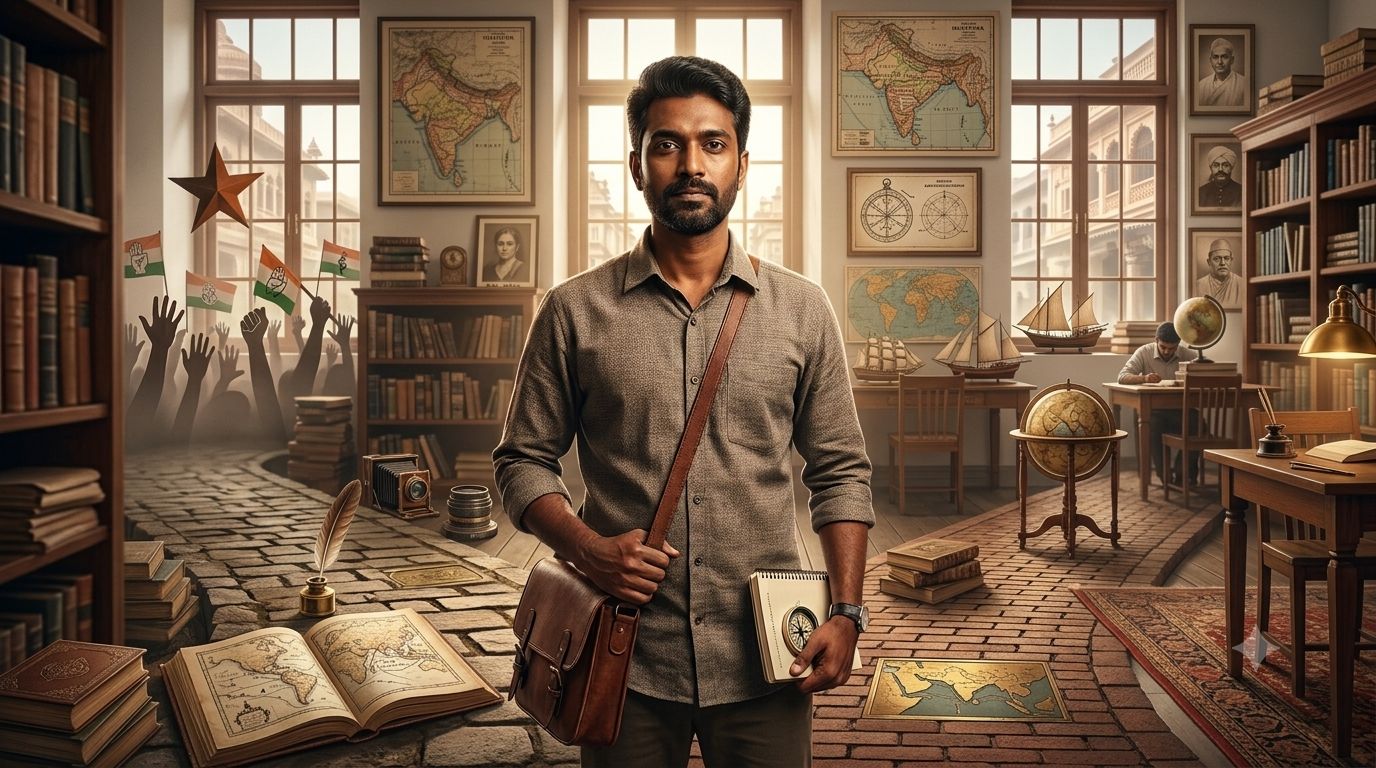
Convictions and compromises: A journey from Idealism to Responsibility

Somnath Pati is an independent researcher and former political consultant with an MA in Modern History from Jawaharlal Nehru University. He writes on identities and social conflict.
There is a peculiar tragedy, and perhaps also a quiet beauty, in growing older. As children and adolescents, we imagine that age merely adds years to our lives. We think maturity is measured by birthdays, degrees, jobs, or the grey hairs that eventually appear on our heads. Only much later do we realise that growing up is actually the slow and often painful process of negotiating with our own certainties. It is the gradual dismantling of convictions we once held with absolute confidence. It is the discovery that life refuses to fit into neat categories of right and wrong, heroes and villains, victories and defeats. Somewhere along the way, idealism does not necessarily disappear, but it learns to coexist with reality. When I look back today, after everything that has happened over the last decade, I often find myself smiling at the younger version of me. Not because he was foolish, but because he believed that the world was much simpler than it really is. I do not mock his dreams. In fact, I owe whatever I have become to those dreams. But I also realise that experience is an unforgiving teacher. It rarely destroys our ideals in a single moment. Instead, it chips away at them slowly, replacing certainty with questions and passion with perspective. My own journey has not been one of changing ideologies as much as it has been one of understanding human beings. Politics, academia, activism, professional life, public service, and even personal relationships have taught me that institutions are ultimately made up of people. It is people, with all their strengths, insecurities, ambitions, fears and contradictions, who determine whether noble ideas survive or perish. Perhaps that has been my greatest education.
As a teenager studying in senior secondary school, politics fascinated me in a way that it fascinates very few young people. I followed debates with genuine excitement. Elections felt like defining moments in the life of the nation. I believed, quite sincerely, that political change could transform society. Like many young Indians of my generation, I watched the anti-corruption movement led by Anna Hazare with admiration. It seemed to represent honesty confronting a deeply compromised political system. For a while, I believed that this movement would fundamentally alter Indian politics. When that hope began to fade, another one emerged. The rise of the BJP appeared to me as the next possibility for national transformation. I was too young even to cast my vote, yet I passionately defended the party on social media. Looking back, I realise that my enthusiasm was born not out of blind loyalty but out of hope. At that age, one naturally wants to believe that there exists a political force capable of correcting the mistakes of the past and building a better future. Every generation seeks such hope, and perhaps every generation eventually discovers its limitations.
College changed me in ways I could never have anticipated. I joined the University of Delhi to study History, and in doing so I unknowingly stepped into an intellectual world that questioned almost everything I had previously taken for granted. History, unlike popular political discourse, rarely permits simple answers. It forces one to understand context, complexity and contradiction. I remain deeply grateful to many of my professors because they taught me something far more valuable than information. They taught me how to think critically. They encouraged us to question inherited assumptions, to examine evidence before reaching conclusions, and to recognise that every historical narrative carries within it multiple perspectives. It would be dishonest to deny that many teachers in the humanities leaned towards Left politics. That is neither an accusation nor a complaint. Universities have always been spaces where ideas compete, evolve and challenge one another. Aristotle had observed centuries ago that man is by nature a political animal, and perhaps nowhere is that observation more visible than within a university campus. Surrounded by new ideas, new books and new conversations, I gradually found myself becoming increasingly sympathetic towards Left thought. Questions of inequality, caste, class, labour and social justice acquired an urgency they had never possessed for me before. The world appeared much larger than electoral politics. It seemed possible that scholarship itself could become a form of public service. Until then, I had imagined my future very differently. Before entering college, I wanted to become an Indian Foreign Service officer. Diplomacy appealed to me because it combined public service with intellectual engagement. Yet the more I immersed myself in historical research, the more I found myself drawn towards academia. I wanted to read, write, teach and contribute to knowledge. Becoming a professor slowly replaced becoming a diplomat as the central aspiration of my life.
With that dream in mind, I prepared for the entrance examination of Jawaharlal Nehru University. Gaining admission into the Centre for Historical Studies to pursue a Master’s in Modern History remains one of the happiest moments of my academic journey. Once again, I had the privilege of learning from teachers whose scholarship profoundly shaped my thinking. They refined my analytical abilities, introduced me to new historiographies and encouraged intellectual independence. If Delhi University had taught me to question, JNU taught me not to fear difficult questions. Yet it was within the same university that I encountered one of the first major contradictions of adult life. Like many students, I became involved in student activism. At first, it appeared to be the natural extension of everything I had been studying. If one believed in justice, equality and democracy, then surely one ought to participate in collective struggles that sought to defend those principles. I entered student politics with sincerity rather than calculation. Over time, however, I began noticing uncomfortable realities. Some professors who eloquently spoke about resistance inside classrooms became remarkably cautious whenever resistance threatened their own institutional positions. Their lectures inspired courage, but their actions often reflected understandable fear. I do not entirely blame them today. Everyone has families, responsibilities and careers. Yet for a young student who still believed that ideas and actions should perfectly mirror one another, the contradiction was impossible to ignore.
Among students too, I witnessed another pattern that slowly repeated itself across ideological lines. Whether one belonged to organisations of the Left or the Right, there were always individuals whose politics seemed to function less as a moral commitment and more as a professional investment. They memorised party positions without questioning them, competed to demonstrate ideological purity in public, cultivated influential seniors and professors, and quietly hoped that these relationships would eventually translate into research opportunities, academic appointments or political careers. To be absolutely fair, there were many genuinely committed people as well. I met individuals whose courage and integrity I continue to admire. But alongside them existed another category of people whose greatest talent was performance. Their convictions changed according to circumstances, but their ambitions remained constant. For the first time, I understood something that no political theory had ever taught me. Hypocrisy has no ideology. It comfortably inhabits every ideology. That realisation stayed with me long after I left the university.
Around the same time, another reality began demanding my attention, one that was far less philosophical and infinitely more immediate. I come from a family that has experienced financial instability. Unlike abstract ideological debates, financial insecurity enters every room of a household. It silently shapes conversations, postpones dreams, influences decisions and often determines the limits within which aspirations must operate. It is easy to romanticise struggle when one has never had to worry about paying bills or supporting ageing parents. It becomes much harder when those concerns become your own. For years, I had believed that changing society was the highest calling one could pursue. Gradually, another question emerged with equal force. What responsibility did I owe to the people who had sacrificed their own comforts to educate me? Was it morally superior to chase an uncertain dream while my family continued to struggle financially? Or was there dignity in first ensuring their security before attempting to change the world? I remembered a remark by Shah Rukh Khan that had once amused me but gradually began making profound sense. He had said that one should first become rich and then become a philosopher. I no longer interpreted that statement literally. Wealth was not the point, stability was. A person constantly worried about survival finds it difficult to think freely. Economic security is not the enemy of idealism. Quite often, it is what allows idealism to endure. It was during this phase that I slowly began letting go of my dream of becoming a professor. The decision was not driven by disappointment alone, although disappointment certainly played its part. I had also become increasingly convinced that academic life, like every other profession, was shaped by networks, institutional politics and personal loyalties. I knew my own temperament well enough to recognise that I was unlikely to flourish in an environment where silence was frequently rewarded more generously than honesty. I have never been particularly gifted at pretending. If I believe something is wrong, I find it difficult to remain silent simply because speaking may prove inconvenient. That quality has earned me both friendships and difficulties, and I suspect it always will. So I chose another path.
I joined Prashant Kishor’s I-PAC as a Research Analyst and moved to Bihar, believing that political consulting would allow me to contribute directly to governance while also gaining practical experience of public life. For nearly two years, I worked with complete sincerity. I travelled, researched, analysed public opinion, spent long hours understanding issues affecting ordinary people and genuinely believed that meaningful political work could improve the lives of those who had remained excluded from development for generations. What I discovered instead was that institutions may change, but human nature often remains remarkably consistent. The political consulting world was different from the university in its language, its pace and its priorities, yet beneath those differences I encountered familiar patterns. There were people of extraordinary intelligence and remarkable commitment, individuals who genuinely wished to improve governance and make politics more responsive to ordinary citizens. Working alongside them was both inspiring and humbling. But there were also many others who appeared to have mastered the art of appearing sincere while remaining deeply invested in personal advancement. Credit often travelled upwards, while responsibility travelled downwards. Genuine effort was frequently overshadowed by visibility. Those who spoke the loudest often seemed to receive the greatest recognition, while those who quietly carried the weight of difficult work remained invisible. None of this was unique to political consulting. It is perhaps the story of almost every profession. Yet when one enters a profession believing that it is driven primarily by public purpose, such discoveries carry a certain emotional weight. I had joined with the hope that I would contribute, in however small a measure, to improving the lives of ordinary people in Bihar. I worked beyond office hours whenever necessary because I genuinely believed that the work mattered. I was not counting hours or calculating promotions. I simply wanted to do justice to the responsibility entrusted to me.
Over time, however, another kind of exhaustion began to settle in. It was not physical fatigue alone. It was the weariness that comes from watching unnecessary office politics consume energy that could have been devoted to meaningful work. Rumours travelled faster than facts. Personal credibility could be damaged by casual gossip. Work-life balance became increasingly difficult to maintain. Deadlines multiplied, expectations grew, and somewhere in the middle of it all, I found myself asking a question that had followed me from one stage of life to another. Was I still moving towards the life I truly wanted? The answer arrived gradually rather than dramatically. There was no single incident that forced me to resign. Instead, it was the quiet accumulation of many small realisations. I recognised that although political consulting had taught me invaluable lessons, it was no longer the place where I imagined spending the rest of my life. I wanted a life that allowed me to contribute to society without constantly sacrificing my own emotional well-being or my responsibilities towards my family.
Around this time, the person who perhaps understood me better than I understood myself gently changed the direction of my life. My partner, Preeti, suggested that I should prepare for the Civil Services. Looking back today, I often wonder why such an obvious possibility had escaped me for so long. Throughout my childhood, public service had always occupied a special place in my imagination. Before academia captivated me, I had dreamt of becoming a diplomat. Even later, whether in universities or in political consulting, the underlying desire had remained the same. I wanted my work to matter beyond my own personal ambitions. Perhaps I had spent so many years searching for purpose that I had overlooked the most direct path towards it. Sometimes the people who love us possess the remarkable ability to recognise our destination before we ourselves can see it clearly. I remain deeply grateful to Preeti for that conversation because it did much more than suggest a career. It altered my understanding of what public service could mean. She helped me realise that idealism and stability need not always exist in opposition to one another. One could earn an honest livelihood, support one’s family and still dedicate oneself to serving society. That simple realisation transformed my thinking. In June 2024, after resigning from Jan Suraaj, I began preparing seriously for the Civil Services examinations. Like thousands of aspirants across the country, I entered a world governed by uncertainty. Competitive examinations possess a peculiar cruelty. They rarely reveal whether one is moving closer to success. Months of preparation often culminate in a few hours of examination, and those few hours sometimes refuse to reflect years of effort. My own journey was no exception.
I appeared for the Bihar Civil Services twice without success. Every unsuccessful attempt carried its own disappointment, not merely because an examination had gone badly but because each result forced me to confront my own self-doubt. During the same period, I also appeared for the Haryana’s Assistant Professor examination without success. I applied to the University of Delhi’s PhD programme, hoping that if public service did not materialise, perhaps academia might once again become a possibility. That too did not work out. For a while, it seemed as though every door I knocked upon remained firmly closed. The only significant academic achievement during that period was qualifying the UGC-NET JRF examination in January 2025. It gave me confidence that I still possessed the intellectual ability to pursue research if circumstances ever demanded it. Yet even that success felt incomplete because my mind had already committed itself to another path. There are moments during long periods of preparation when one begins questioning not merely one’s strategy but one’s entire identity. Friends move ahead in their careers. Some marry, others purchase homes, many begin living lives that appear settled and predictable. Meanwhile, the aspirant lives inside a strange suspension of time, measuring months through examination notifications, answer-writing practice and cut-off predictions. It is an existence that teaches patience in ways few other experiences can. What sustained me during those uncertain months was not extraordinary confidence. It was simply the refusal to abandon the journey halfway. Somewhere deep within, I continued believing that sincere effort deserved one final chance. That chance arrived in Odisha.
The Preliminary Examination of the Odisha Civil Services was held in October 2025, followed by the Main Examination in February 2026 and the Personality Test in May 2026. I approached each stage with determination, but also with the emotional caution that repeated failures teach a person. I had learnt not to celebrate too early, nor to despair too quickly. When the final result was declared in May 2026 and I saw my name at Rank 17, I did not experience the dramatic burst of emotion that films often portray. Instead, what I felt was an extraordinary stillness. It seemed as though years of uncertainty had finally found their conclusion. Every disappointment, every examination that had not gone my way, every difficult decision, every moment of self-doubt had quietly converged into that single result. For my family, the significance of that moment extended far beyond a rank or a government position. It represented freedom from a financial insecurity that had lingered for years. I knew that the burdens my parents had silently carried would become lighter. For the first time, I could look towards the future without the persistent anxiety that accompanies economic uncertainty. It was not merely my success. It belonged equally to everyone who had believed in me long before I had achieved anything worthy of recognition. Yet what moved me most was something else. I realised that I had not abandoned my ideals after all. For years, I had feared that choosing stability meant surrendering conviction. I now understood that the two need not be enemies. Public service through the Civil Services offered me an opportunity to combine both responsibility and purpose. It would never allow me to solve every problem confronting society. No profession can make such a promise. But it would at least place me in a position where my work could meaningfully improve the lives of ordinary people while also allowing me to fulfil my responsibilities towards those who had stood by me all my life. That balance, I realised, was what I had been searching for all along.
There is a popular tendency today to view every institution through the lens of cynicism. Civil servants are often dismissed as corrupt, arrogant or indifferent. Unfortunately, there are enough examples in our society to explain why such perceptions exist. Power has always tempted human beings, and public office is no exception. Many honest citizens have suffered because of those who misused authority. Yet experience has made me cautious of sweeping judgments. I have lived in universities, in political organisations and now entered public service. If there is one lesson that these different worlds have taught me, it is that no institution possesses a monopoly over either virtue or hypocrisy. There are courageous professors and timid professors. There are selfless activists and performative activists. There are honest politicians and dishonest politicians. Likewise, there are civil servants who quietly dedicate their lives to public welfare despite transfers, political pressure, threats and professional isolation, just as there are others who fail the responsibilities entrusted to them. Human beings carry their character with them. Institutions merely provide different stages upon which that character is revealed. Whenever discussions about morality become too simplistic, I find myself returning to another question. Who among us truly pays the price for our convictions? We celebrate courage very easily after the danger has passed. We write heartfelt tributes. We post photographs. We express solidarity through carefully worded social media updates. We praise those who stood alone, often after they have already suffered the consequences of standing alone. But while they are alive, when they are threatened, isolated or punished for refusing to compromise, how many of us willingly risk our own comfort to stand beside them? It is a difficult question because it refuses to spare anyone, including myself. We all admire courage. Far fewer of us are prepared to bear its consequences. Perhaps that is why maturity has gradually taught me to become less interested in what people proclaim and more interested in what they practise. Beautiful speeches, revolutionary slogans and fashionable opinions have their place, but character ultimately reveals itself not in moments of applause but in moments of personal risk. Anyone can defend principles when doing so is convenient. The real test arrives when those principles begin demanding something from us in return. It took me many years to understand that distinction.
Today, when I think about success, my definition has changed completely. There was a time when I believed success meant becoming a professor, a diplomat or earning recognition in academic circles. Later, I believed success lay in influencing politics from within. Today, I have come to understand success very differently. Success is being able to look at my parents without feeling that their sacrifices were in vain. It is knowing that the people who love me can look towards the future without fear or uncertainty. It is earning an honest livelihood, remaining intellectually curious even after professional success arrives, refusing to become bitter despite disappointments, and preserving empathy in a world that often rewards indifference. Above all, success is becoming someone whom my younger self would still recognise, even if he occasionally disagrees with the path I chose to reach here. There is one person without whom this transformation would perhaps never have taken place, and that is my partner, Preeti. She entered my life not merely as a companion but as someone who quietly altered the direction of my thinking. At a time when I found myself suspended between uncertainty and aspiration, she helped me realise that public service and personal responsibility did not have to exist in conflict. It was she who encouraged me to prepare for the Civil Services, reminding me that one could serve society while also giving one’s family the stability and security they deserved. Looking back today, I cannot thank her enough for that simple yet life-changing conversation. Sometimes the people who love us do not merely walk beside us; they help us discover the road we were always meant to take.
Throughout this journey, I have often found myself returning to the words of Dr. B.R. Ambedkar, one of the greatest inspirations of my life: “Life should be great rather than long.” As I have grown older, those words have acquired a meaning that I perhaps could not fully appreciate in my youth. Greatness does not necessarily lie in dramatic sacrifices or in becoming a celebrated figure. More often, it lies in living a life of purpose, integrity and responsibility. It lies in using whatever opportunities one has to make life a little more dignified for those who have fewer privileges than oneself, while remaining honest enough to acknowledge one’s own limitations. As I conclude these reflections, I find myself returning to another sentence that has stayed with me for years. It was printed on an old grey full-sleeved T-shirt that I have always loved, and over time those simple words have come to mean far more than I had imagined. “When writing the story of your life, don’t let anyone else hold the pen.” The older I grow, the more I understand the wisdom contained in that single sentence. People will always have opinions about the choices you make. Some will think you compromised too much, while others will think you did not compromise enough. Some will celebrate your successes, while others will quietly resent them. There will always be those who reduce your life to a single label because labels are easier than understanding human beings. You cannot become the hero of everyone’s story, nor should you spend your life trying to be. What you can do is live honestly enough that, when you look back many years from now, you recognise the person whose story you have written.
If there is one lesson that my journey has taught me, it is this: never lose your ideals, but never allow them to become blind to reality. Love your family without guilt. Earn your bread with dignity. Continue to think critically, continue to question authority, including your own assumptions, and continue to stand with those who need justice whenever you are in a position to do so. Build a life in which conviction and responsibility strengthen rather than weaken one another. When I was seventeen, I believed history was changed by extraordinary people. Today, I think history is sustained by ordinary men and women who continue doing the right thing long after the applause has faded. I no longer dream of changing the world overnight. If, over the next few decades, I can make life a little more dignified for the people whose paths cross mine, if I can return home each evening without being ashamed of the decisions I took during the day, and if my parents and the people I love can sleep peacefully knowing that I remained true to both my responsibilities and my convictions, I shall consider that a life well lived. Everything else is merely commentary.




 Login
Login