
Inherited Silence: Social construction of a silent father

Dr. Ranu Tomar is an assistant Professor and academic consultant practicing research interests covering Gender Studies, Communication & Mass Media, and Feminist Research Methodology.
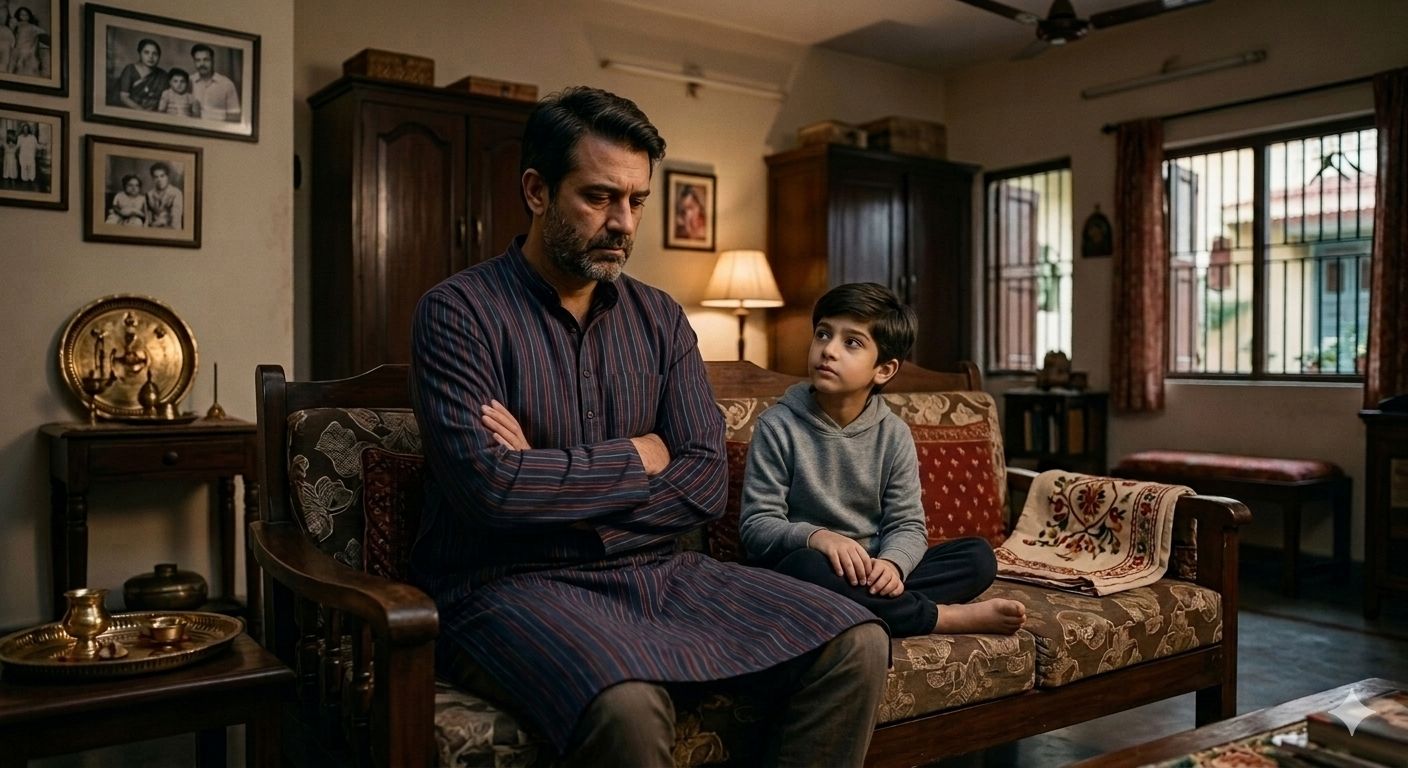
In a single “moment,” profoundly deep emotions are both expressed and left unspoken. “Silence,” too, stands witness to such moments. Within the social structure where men are often perceived as “stone-hearted,” there also exist extremely tender moments that shape a man’s silence. A father’s silence is one such powerful testament to emotions gradually hardening into unmelting stone.
A father is a social institution in which becoming insensitive toward oneself is made into a continuous social process. Thus, the nurturing aspect within a man — the part symbolic of femininity — is deliberately rendered inactive. For years, fathers gather themselves into this silence, sustain themselves within it, gradually grow weary, and are eventually assumed to be fully absorbed into it. This becomes so destructive that even in a huge house, the father often sits alone in the front room, carrying a socially assigned, self-accepted, and self-described silence. The very house for whose creation he was first taken away from it for years in pursuit of livelihood, then burdened by familial responsibilities, and finally left within that same house accompanied only by silence.
A father is also a son, a brother, an uncle, a husband, a friend, a lover, and a provider. Most importantly, he is also a “sensitive human being” – yet even acknowledging this becomes difficult because fathers are overwhelmingly analyzed only through the lens of “patriarchy.” It is only through meaningful dialogue and compassionate intervention that one can reach the deepest and most delicate layers of a father’s emotional world. Perhaps this is why fathers need a qualifier – “a sensitive father” – so that they, too, may be recognized as individual human beings with their own subjective emotional realities.
Emotional suppression, patriarchy, and the living room silence
A father bears the burden imposed by patriarchal orthodoxy, where he is encouraged to become emotionally numb, and where displays of force and power eventually make violence seem inevitable. It is essential to understand the emotional depths hidden beneath silence. Suppressing one’s own expression is a form of self-violence, one that can eventually distort itself into violence of any kind.
Dialogue is a solution. That is why patriarchy teaches men to wear a “stone-like silence” in order to maintain structures of power. This silence is unsettled by conversation and resists resolution. Consequently, even simple dialogue – especially playful, warm, or emotionally open dialogue – begins to feel like a transgression against that patriarchal silence.
Perhaps the most difficult dimension is the silence between father and son – a mechanism of inherited power that transfers the stonelike rigidity of social structures across generations. A son often cannot understand his father’s silence because the process of numbing the son’s own sensitivity is itself treated as a social necessity. Even if the son tries to reach out, his curiosity is redirected toward a world where natural expressions of longing and vulnerability are considered inappropriate.
Inherited quiet between fathers and sons
In large households, the image of the father sitting silently in the front room becomes a tradition — one that the son, too, silently accepts through sparse conversations or complete absence of dialogue. Perhaps the son already senses that one day he, too, will sit in that same front room carrying his own self-accepted stone-like silence.
That is why embracing one’s father wholeheartedly matters. Being able to share one’s struggles with him matters. Listening to his understanding of the world matters. Understanding the moments when he silently absorbed humiliation and rebuilt his ideals within himself matters. Hearing about the times he intervened socially and fought to secure justice for his life partner within the family matters. Listening to how, for the sake of his children, he compressed his desires, habits, moods, and joys into merely two pairs of clothes.
Perhaps this is why once a shirt gifted to a father never truly feels comfortable to him. Because he does not measure its worth merely in money; instead, he sees within it the long process through which he gradually confined himself to silence in the front room of his own house — a process in which he sacrificed the unique self-bestowed upon him by existence itself. When he asks, “How much did it cost?” or says, “Why spend so much?” an experienced and sensitive father is revealing the equation of his stone-like silence. That is why fathers often become uneasy when receiving gifts.
Listen to Silent Father to initiate conversation
The social institution father doesn’t create space to let the son listen to father’s silent emotions held back for years. Ironically the words ‘Listen’ and ‘Silent’ both have the same letters, that’s why it requires the same amount of willingness and intention to initiate the dialogue between father and son. Despite having the common power placement in patriarchy rarely they both are made socially eligible to sit on a common table for a participatory conversation. It remains a missed communication and conversation which perhaps never or rarely takes place in family. This reinforces the hierarchical communication where father – son share only a few word-count for the conversation with no experience to their bond. Unfortunately, patriarchy projects both father and son as an authority to compete over resources and status which hinders the cordial communication possibilities under patriarchal power relations. Our social structures do not enable any of the individuals to express their genuine emotions and feelings, men are the chosen victim to kill their constructive sensitivity in this process. The genuineness of emotion disempowers rational of patriarchal power and its operation over the submissive silences. Thus the culture of silencing and suppression of the emotion deforms the expression of bonds within the members of the family. The lack of emotional nurturing keeps the social fabric fertile for the socially sanctioned violence or domestic violence in patriarchal spaces. The chasm between silent and listen widens that it reduces any possibility to initiate the conversation because it is stigmatized if a man recognizes himself as a naturally sensitive social being who is all capable to feel, sense and open the elevation of bonds within family structure.
Neither did we truly learn how to ask fathers about themselves, nor did we gather the courage to tell them about ourselves. We simply allowed the father’s silence to become institutionalized and revered. It keeps an unsaid and misunderstood bond of limiting the genuine experiences of being a father and a son.
This stone-like silence in families is what decorates the so-called stone heart — and only dialogue based on self-conviction and genuine curiosity has the power to pierce it.



 Login
Login