“We Are Indians Too”: From the North east

Kongkita studies public policy at the University of Bristol
From colonial labels to everyday slurs, the indifference towards Northeasterners is not an accident. It could be traced back with deep roots, and it demands more than sympathy.
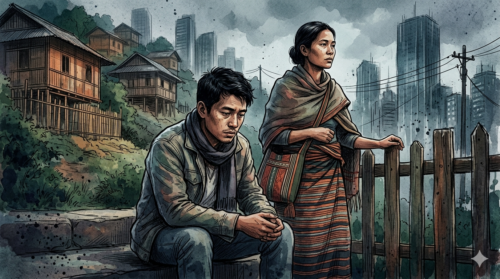
It is both strange and worrisome that the racial attack on a group of professional dancers from the Northeast, India, who were racially abused and denied washroom access in Patna, and another recent racial attack on two women from Arunachal Pradesh in Delhi doesn’t take a Northeasterner like me by surprise. Yet it somehow always manages to fill my core with disgust and raises a plethora of questions I cannot shake. Just a quick online search and you surface headline after headline screaming the same story, in different years, with different names. Hence, the question that never goes away rears its head again: when does it stop? Why must we keep waiting for another 24-year-old Anjel Chakma, another Richard Loitam, another Nido Tania, to face the full wrath of mainland racism and die?
To understand what is happening today, we need to go back, not as an academic exercise, but because the past refuses to stay buried. As William Faulkner said it best: “The past is never dead. It’s not even past.” The alienation of the Northeast did not begin with a viral video or a flashy news story. It began with the British Raj, from the very moment Sir Alexander Mackenzie coined the administrative term ‘North-East,’ drawing a line around a people and a region. Even before that formal naming, colonial administrators had already decided what the people of this region were: ‘wild,’ ‘primitive,’ ‘savage.’ They were cast as India’s ‘Mongoloid’ periphery, a marginal outpost seen as racially and culturally apart from the rest of the subcontinent. In no way was this neutral geography. Indeed, it was a deliberate othering, and it laid the psychological groundwork for everything that followed.
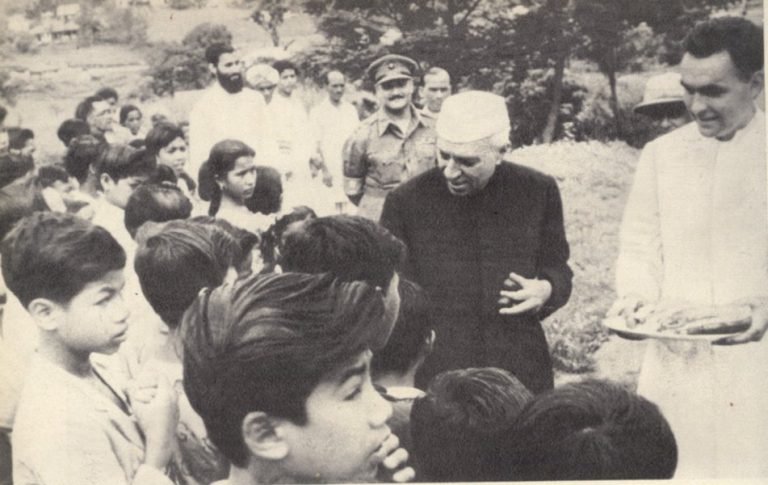
The postcolonial era proved no different; only the form changed. What replaced British rule in the Northeast was what can only be called centre-colonialism, i.e., the imposition of hard military power by the Central government on its own northeastern citizens. Before many of us were old enough to understand words like “rape” or “political oppression,” we were already growing up hearing stories of our women being assaulted by armed personnel, of fathers and uncles dragged from their homes and beaten until their spines broke, and just on the mere suspicion of anti-government activity. We grew up learning, too, that in our most vulnerable moment, when Chinese forces were advancing toward us, what visionary Jawaharlal Nehru said, the now-infamous words: “My heart goes out to the people of Assam.” The reason for bringing this up is that the sense of abandonment encoded in that statement are not isolated historical footnotes. They are branches of the same tree that still casts its shadow. By the late 1990s and early 2000s, extending what they called a development embrace through the Look East Policy in 2003, the Act East Policy in 2014, and various other overtures, the Central government turned on its charm, while quietly maintaining the same centre-to-periphery power structure underneath.
This economic opening marked a wave of migration, and young people from Arunachal Pradesh, Assam, Manipur, Meghalaya, Mizoram, Nagaland, Sikkim, and Tripura poured into Mumbai, Delhi, Bengaluru, and Kolkata in search of education and employment opportunities. And it was there, in those cities that proudly announce themselves cosmopolitan, that they encountered racism: overt and subtle, organised and casual, hostile and smilingly ignorant. Even as UNESCO formally declared the concept of biological ‘race’ scientifically invalid in the 1950s. But racism in contemporary India did not disappear; rather, it simply reinvented itself.
I have been trying to pinpoint when I first became acutely aware of my own identity. Reflecting on it, I think the deeper awareness began the moment I found myself among people outside my home community, people who did not speak Assamese, who did not share my references or recognise my world. Growing up surrounded by people who understand your culture, your identity feels unremarkable, simply the way things are. It is only when you step into a more heterogeneous, mainland setting that differences snap into focus, especially when you are confronted suddenly and repeatedly with the misconceptions people have been carrying about you all along.
How do you know when someone is racist? The most obvious answer would be when they treat you differently or actively discriminate against you on the basis of your race or ethnic identity. But racism doesn’t always arrive with that kind of force; it also comes quietly. At least once, almost all of us from the Northeast have experienced it, directly or in its subtler, almost polite forms, and it never comes with positive connotations. Food racism, fashion stereotypes, and the casual assumptions of self-declared liberals are the most frequent offenders. The peak came during the COVID-19 pandemic, when discrimination against Northeasterners intensified sharply and more visibly. Some were spat at and abused for supposedly carrying the virus, while others endured the slow-burning indignity of thinly veiled disgust and suspicion tied to presumed Chinese affiliation.
Racism is not always loud. Sometimes it is a quiet assumption, a comment so small it barely registers and chips away at you slowly and without warning.
Let me offer one experience from among many of my own. One peak winter in North India, a group of us was huddled over tea at a roadside stall. When I shivered and complained about the biting cold, the gaze was suddenly directed towards me when someone genuinely looked surprised and asked why I was feeling it at all, given where I came from. The assumption was crystal clear: the people from the Northeast must be permanently acclimatised to freezing temperatures and therefore immune to ordinary winter. It was a small remark, almost offhand, but it revealed something larger, a sweeping misconception that compresses eight extraordinarily diverse states into a single, vague, frigid stereotype.
On a separate occasion, when I mentioned my fondness for pork, a person responded with dismissive confidence: “Waise tum log toh sab kuch khate ho,” roughly meaning that people from my region consume anything and everything. Well, this implication was not curiosity. It was contempt dressed as observation. These generalisations, however small they might be, are delivered with a certainty that requires no verification, no reflection. I pushed back both times.
I believed then, as I do now, that it matters to do so.
We often dismiss these moments as minor, as we feel they are not worth the energy. Many of us shrug them off, or worse, laugh along, to keep the air light and avoid confrontation. But, smiling through a racial joke doesn’t defuse it; it quietly validates it, signaling to everyone watching that this kind of humour is acceptable. Slurs like “Chinki,” “Chinese,” “Momo,” and “Chowmein” have been stamped onto us like brand names, casual identifiers that reduce a person to a caricature.
We are treated as ‘exotic,’ and rather than as equal citizens, we are treated as objects of fascination. And, when it goes unnamed and unchallenged, it can very quickly curdle into something uglier. It only takes one Ruby Jain and Harsh Singh from Delhi’s Malviya Nagar to say aloud what others have been thinking quietly for the bias to become impossible to ignore.
Another one is a more calculated kind of distortion at work, one that wears the costume of storytelling. An entire cohort of mainland podcasters, YouTubers, and armchair commentators has appointed itself the authority on the Northeast, retelling our stories from air-conditioned studios, bending and trimming into a Sanskritised, pan-India-friendly narrative because why not? That version travels better and earns more clicks. Indigenous cultures and the local political histories of the region’s people are quietly edited out to fit the mainstream narrative, because an uncomfortable truth is always a harder sell than a familiar myth. Furthermore, Mainstream Hindi cinema and web series do the same lazy work from a different angle. They reduce the Northeast to misty hills, backwardness, vague menace, and ‘savage’ problems waiting for an outsider hero to arrive and fix. None of this is innocent. This ingrains the idea that the Northeast exists only as a problem to be managed, not a place to be genuinely known.
We need to be clear about what we are naming here. Racism against people from Arunachal Pradesh, Assam, Manipur, Meghalaya, Mizoram, Nagaland, Sikkim, and Tripura is not about one bad incident or one careless person. It is about those interlocking patterns that shape how people are perceived, and over time, how we come to perceive ourselves. When a community’s culture, food, appearance, and identity are met not with genuine curiosity but with jokes, suspicion, and exoticisation, the promise of equal citizenship loses its credibility. It is exhausting to be made to prove, constantly, that you belong, especially given the extraordinary internal diversity of the Northeast, where each of those eight states is strikingly and beautifully distinct from the others, yet all are collapsed into the same stereotypical representation in popular imagination and on social media.
The deeper tragedy is that we, Northeasterners, are expected to explain ourselves even before we get the chance to express ourselves. This kind of expectation leaves a particular kind of exhaustion, the exhaustion of being required to justify our presence, because people of our own country have chosen not to learn. India takes great pride in its unity in diversity and in philosophies like Vasudhaiva Kutumbakam, meaning the world is one family. Surprisingly and very sadly, that pride rings hollow when the nation cannot extend the same warmth to its citizens who still hear, on Delhi’s streets, in Mumbai’s offices, in homes and hostels and train compartments, that they do not quite belong. The message, delivered with a smile or a slur, depending on the day, is always the same: you are visible, but not fully accepted.
It is high time to say this very plainly: this racism is not imported. It is homegrown. And, it will not change because we wish for it to. It changes when we challenge it in ordinary moments, when we refuse to let that small remark slide, when we call it out the way those two brave women from Arunachal Pradesh did, and when individual courage is backed by clear, enforceable institutional action.
The day it becomes more natural for someone to say “I know something about this place” rather than “Where even is that?” or “I have been there” rather than “Is it safe?”, we will know there’s genuine hope for something to change for the long term.
 Login
Login